Here is the thing about Christmas hot cocoa station ideas: they work because they solve a real December problem. Every cold evening, someone wants cocoa, and every time the whole kitchen gets opened — the cocoa tin from the back of the cupboard, the marshmallows from a different shelf, the mugs from wherever they landed. A cocoa station ends that hunt. One tray, three jars, two mugs, and a kettle or cocoa mix in one spot, and the nightly cocoa ritual takes two minutes instead of ten. This guide gives you 12 setups built that way, for a kitchen counter, a bar cart, or a sideboard, with real costs and real measurements, so you can build yours in a single afternoon.
Every idea below carries a real cost, so you can pick the setup that fits your space and your budget before you buy anything. The station sits inside the wider Christmas kitchen story: the garland and fairy-light tricks come from our Christmas kitchen decor ideas, the table styling pairs with our Christmas tablescape ideas, and the cocoa jars double as a gift idea in our DIY Christmas gifts under $25, so the station is one piece of a coordinated December, not a lone decoration.
Pick the Spot First: Ideas 1 to 3
1. The kitchen counter corner — $0, 10 minutes. The classic spot is the least-used 18 inches of kitchen counter, usually the corner between the coffee maker and the wall. Measure it first: the station needs about 18 inches wide and 12 inches deep, and it must sit at least 6 inches from the stove and the sink, so steam and splashes never reach the jars. The cost is zero if you already own a tray, because the spot itself is free — the counter is already there, and the station just claims a corner of it. Keep the rest of the counter clear, because a station that sprawls across the whole worktop stops being charming and starts being in the way of dinner. Our Christmas kitchen decor ideas use the same one-styled-zone rule for the whole room.
2. The bar cart station — $25 to $80, 20 minutes. If the counter cannot spare 18 inches, a bar cart is the better home: it rolls out of the way when you need the kitchen, rolls beside the sofa for movie night, and holds the whole station on two shelves. A thrifted cart costs $25 to $40, a new brass or wood one $60 to $80, and the setup is the same as the counter version — tray on top, jars and mugs on the top shelf, spare supplies on the lower shelf. Hang the mugs from small hooks on the cart rail, as in the photo below, and the cart holds four mugs without using a single inch of shelf. This is the station for small kitchens and for anyone who wants cocoa in the living room, not just the kitchen.
3. The sideboard or coffee bar — $0 to $15, 15 minutes. A sideboard, a console table, or an existing coffee bar makes a beautiful station because it already lives where people gather, and it does not compete with cooking. The tray goes on top, the jars line up behind it, and a small bowl of candy canes fills the gap. If the sideboard is in the dining room, the station doubles as the after-dinner cocoa stop, which is exactly how it gets used most — guests help themselves instead of asking. The only cost is the tray if you do not own one, $10 to $15, and a $5 string of battery fairy lights to mark the station out after dark. Keep the station at the end of the sideboard nearest the kitchen, so refills are a short walk, not a trek.
The Tray Formula: Ideas 4 to 6
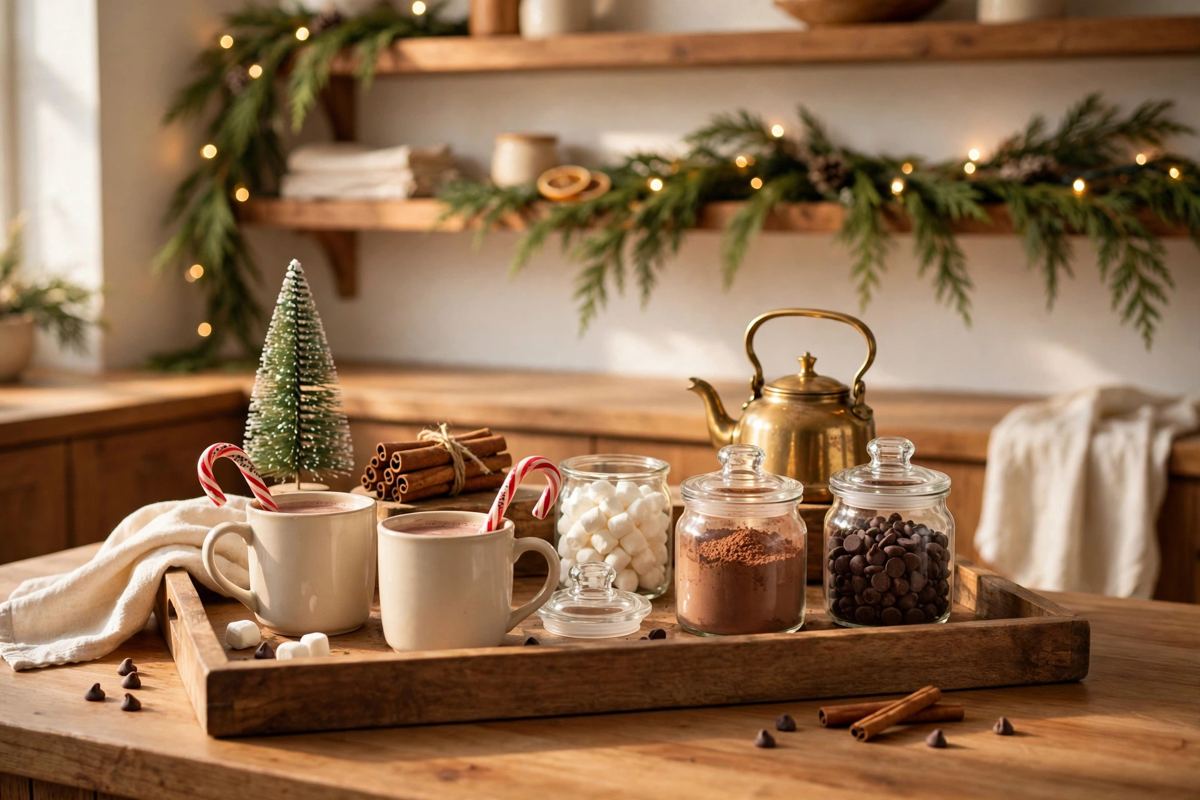
4. The wooden tray base — $10 to $25, 5 minutes. Every good station starts with a tray, because the tray is what makes it a station instead of a cluttered counter. A wooden tray about 14 by 18 inches with handles costs $10 to $25, and it holds two mugs, three topping jars, and a small kettle or cocoa mix jar without crowding. The handles matter more than the wood: they let you lift the whole station aside when you need the counter for cooking, and carry it to the table for a cocoa night. A baking sheet works in a pinch, but it has no lip, so jars slide; a tray with a raised edge keeps everything contained. This is the single most important purchase in the whole guide — spend the $15 here and save yourself the daily tidy-up.
5. The tiered tray — $15 to $30, 10 minutes. A two-tier tray is the small-space hero of the cocoa world: the bottom tier holds the mugs and the cocoa mix, the top tier holds the topping jars and a mini bottle-brush tree, and the whole station uses about 10 inches of counter instead of 18. A metal or wood tiered tray costs $15 to $30, and the trick is keeping the top tier light — jars of marshmallows and candy cane, not a heavy kettle — so the tray never wobbles. Put the heaviest thing, the cocoa mix jar, on the bottom tier, and the station stays stable even when someone reaches across it. If your station lives on a cart, the tiered tray is the move, because it doubles the display space without widening the footprint.
6. The baking-sheet shortcut — $0 to $8, 5 minutes. If the budget is truly zero, a rimmed baking sheet you already own is a perfectly good tray: it has the lip, it is easy to wipe clean, and it costs nothing. Dress it up with a folded tea towel underneath so the jars do not slide and the metal does not show, and suddenly it reads as intentional rather than improvised. A new rimmed sheet costs $6 to $8 if you do not own one, which still makes this the cheapest base on the list. The trade-off is honest: a baking sheet has no handles, so moving the station means carrying it with two hands, and it looks plain from the side. For a first December station, though, it is the right call — spend the money on the toppings, not the tray.
Topping Jars That Do the Work: Ideas 7 and 8
7. The three-jar topping lineup — $12 to $25, 15 minutes. The heart of the station is three glass jars with lids: mini marshmallows, crushed candy cane, and chocolate chips, as in the photo below. Glass jars cost $3 to $6 each, and the toppings cost about $8 to $12 total — a bag of mini marshmallows $3, a box of candy canes $3, a bag of chocolate chips $4. Use jars with real lids, never open bowls, because open toppings go stale in a week and collect kitchen dust; airtight jars keep marshmallows soft for three weeks and candy cane crisp for months. Add a small wooden scoop to each jar, $1 to $2 each, because scoops keep fingers out of the toppings and make the station feel like a real cocoa bar instead of a pantry shelf. Label the jars with kraft tags or chalkboard stickers, $2 to $3 for a set, so guests know what is what without asking.
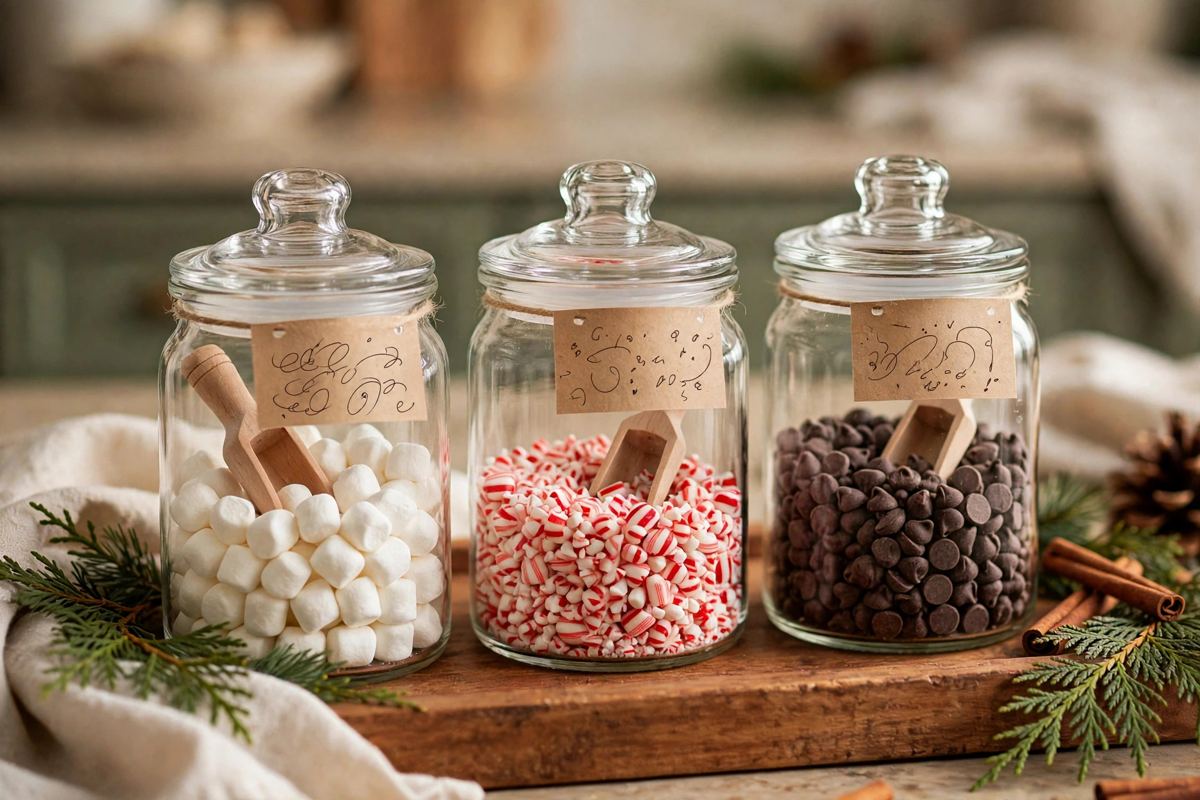
8. The cocoa mix jar and the homemade mix — $5 to $12, 20 minutes. The second jar on the station is the cocoa itself, and homemade mix beats store-bought for about the same money. Mix 2 cups of cocoa powder, 2 cups of powdered sugar, 1 cup of powdered milk, and a pinch of salt in a large jar — about $5 to $8 of ingredients makes roughly 20 mugs, which is about 30 cents a mug against $1 or more for single-serve packets. Put 3 tablespoons of mix per mug of hot milk, stir, and the cocoa is done. Keep the mix in a wide-mouth jar with a scoop, because a narrow jar means fishing with a spoon, and write the ratio on the tag so guests can make their own. If you would rather buy, a good cocoa mix jar costs $6 to $12 and works just as well — the station does not care where the cocoa came from, only that it is in a jar with a scoop.
Mugs, Stirrers and the Little Details: Ideas 9 and 10
9. The mug display — $0 to $20, 10 minutes. Two mugs live on the tray, ready to use; the rest hang nearby so the station never looks bare. Hang mugs from small adhesive hooks under a shelf, $3 to $5 for a set of hooks, or from the rail of a bar cart, or stack two on a small mug tree, $8 to $15. Mixed mugs look better than matching ones here — a cream mug, a burgundy mug, a speckled stoneware mug, all in the same warm palette, read as collected rather than bought as a set. Keep the mugs to four at most on display, because a wall of twelve mugs stops being a station and starts being a cupboard door. The mugs you already own are the right mugs; buy new ones only if every mug in the house is chipped or plain white, and then buy two, not six.
10. Stirrers, spoons and the candy cane trick — $3 to $8, 5 minutes. The smallest details are what make guests smile: candy cane stirrers, cinnamon sticks, and a little bowl of chocolate curls. A box of candy canes costs $3 and gives you a dozen stirrers — drop one in each mug and it melts into the cocoa, sweetening and flavoring it at the same time. Cinnamon sticks cost $2 to $3 for a bundle and double as stirrers and as decoration tucked beside the jars. Add a small spoon rest or a folded napkin under the stirrers, because a wet candy cane on a wood tray leaves a sticky ring, and the station should wipe clean in one pass. This is the cheapest idea on the list and the one guests photograph most, which tells you everything about what a cocoa station really is: a small, generous ritual, not a big purchase.
Signs, Light and the Final Layer: Ideas 11 and 12
11. The sign and the menu — $5 to $15, 15 minutes. A small sign turns a tray of jars into a station: a chalkboard, a wooden plaque, or a framed print that says "Hot Cocoa" and, if you like, lists the toppings. A small chalkboard costs $5 to $8, a wooden sign $8 to $15, and a printed card in a frame you already own costs nothing. Write the menu in chalk or on a card — cocoa, marshmallows, candy cane, chocolate chips — because a menu tells guests they are allowed to help themselves, which is the whole point of a station. Keep the sign small, about 5 by 7 inches, and prop it at the back of the tray so it never blocks the jars. If handwriting is not your thing, a printed card in a plain frame looks just as good and never smudges.
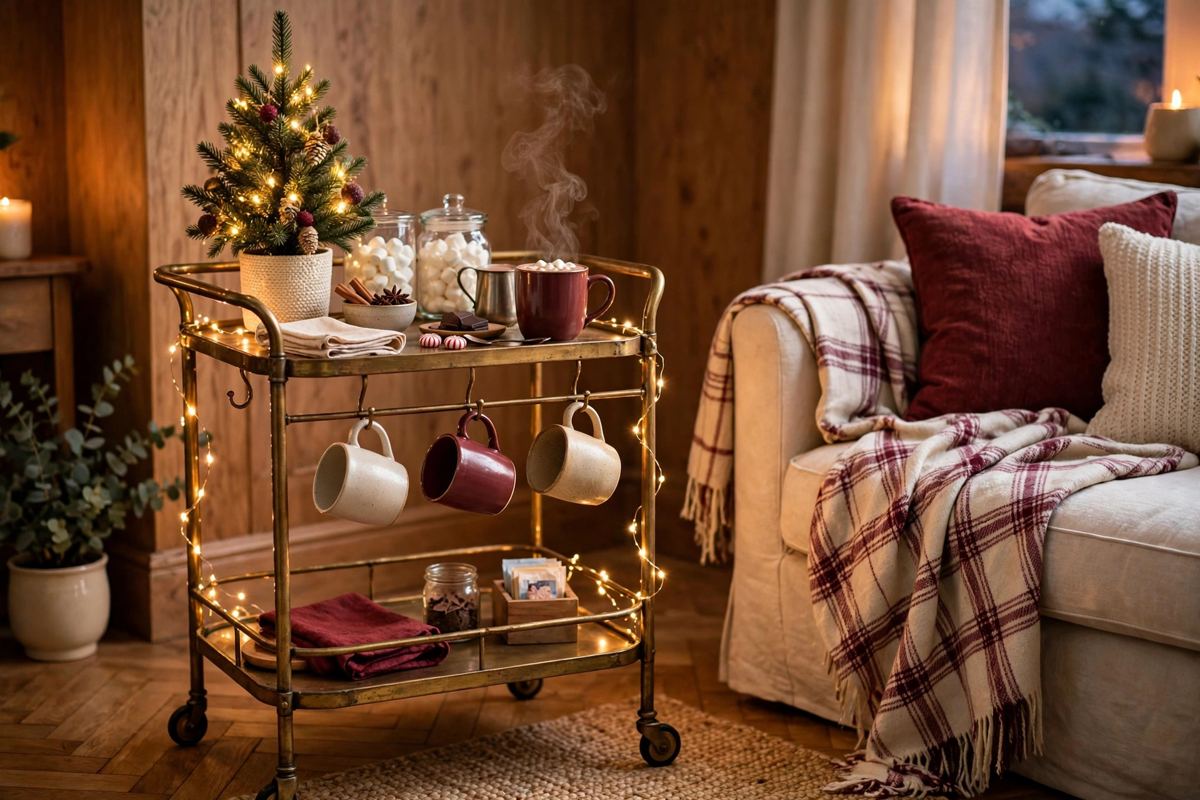
12. Fairy lights and a touch of green — $5 to $12, 10 minutes. The final layer is light and green, and it is what makes the station read as Christmas rather than just a coffee corner. One battery fairy-light string, $5 to $8, draped along the shelf above the station or wrapped around the cart rail, gives the whole corner a warm glow after dark — warm white only, because cool white reads as a shop display. Add one small sprig of cedar or a mini bottle-brush tree, $3 to $5, tucked behind the jars, and the station is done. Do not add more: a second garland, a second string of lights, or a big wreath behind the station crowds the jars and makes the station hard to use. One light string, one sprig of green, and stop — the cocoa is the star, and the decoration is just the frame around it.
The One-Afternoon Setup and Real Costs
Start on a Saturday afternoon with the spot: measure the counter corner, the cart, or the sideboard, and confirm the 18 inches by 12 inches the station needs, with 6 inches of clearance from the stove and the sink. Next, set the tray down empty and arrange the jars on it before filling them — three topping jars across the back, the cocoa mix jar beside them, two mugs in front — because it is easier to move empty jars than full ones. Then fill the jars, add the scoops and the tags, hang the mugs, prop the sign, and drape the fairy lights. Finally, make a test mug: hot milk, 3 tablespoons of mix, a candy cane stirrer, and a spoonful of marshmallows, and sit with it for ten minutes to check the station works the way you will actually use it. If you have to reach across the jars to get a mug, or the light string dangles into the cocoa, move things now, not on the first night guests arrive. The whole build takes under an hour, and most of that time is the shopping, not the setup.
On cost, a full station — a wooden tray, three jars with scoops and tags, a cocoa mix jar, a chalkboard sign, a fairy-light string, and the toppings — runs about $45 to $75 if you buy everything new. A tray-first station, using a baking sheet and mugs and jars you already own, costs $15 to $25 for the toppings, the lights, and the candy canes. A zero-buy station, built entirely from the kitchen you already have, costs $8 to $12 for the toppings alone. The best value on the list is the homemade cocoa mix at about 30 cents a mug, because it pays for the whole station in a month of nightly cocoa. And when January comes, the station packs into one box — jars washed, tray wiped, lights coiled around a piece of cardboard — ready to come back next December in under an hour. If you are hosting friends for the holidays, our Friendsgiving decor ideas show how a cocoa station fits a relaxed gathering, and the jars themselves make a lovely gift, as in our DIY Christmas gifts under $25.
Mistakes to Avoid
- Putting the station next to the stove. Steam fogs the jars and melts the marshmallows. Keep 6 inches of clearance, minimum, from heat and from the sink.
- Open bowls instead of lidded jars. Toppings go stale in a week and collect dust. Airtight jars keep everything fresh for three weeks or more.
- Too many toppings. Eight jars looks generous and is a mess to maintain. Three jars is the sweet spot; five is the absolute maximum.
- Cool white fairy lights. Blue-white light reads as a shop display. Warm white is the only choice for a cocoa corner.
- Matching mugs only. A station of identical mugs looks like a store display. Mixed mugs in one warm palette look collected and lived-in.
- No scoop in the jars. Fingers in the marshmallows end the station's charm fast. A $1 wooden scoop per jar is non-negotiable.
- Forgetting the refill ritual. A station with one marshmallow left looks abandoned. Refill the jars every Sunday night so it always looks intentional.