Here is the truth about Christmas kitchen decor: the kitchen is where everyone actually ends up. Not the living room with the tree, not the mantel you styled for hours — the kitchen, leaning on the counter with a mug in hand. Yet it is the room most people decorate last, with whatever is left over, because it feels like a working room, not a decorating room. These Christmas kitchen decor ideas fix that, without turning your counters into a display you cannot cook on.
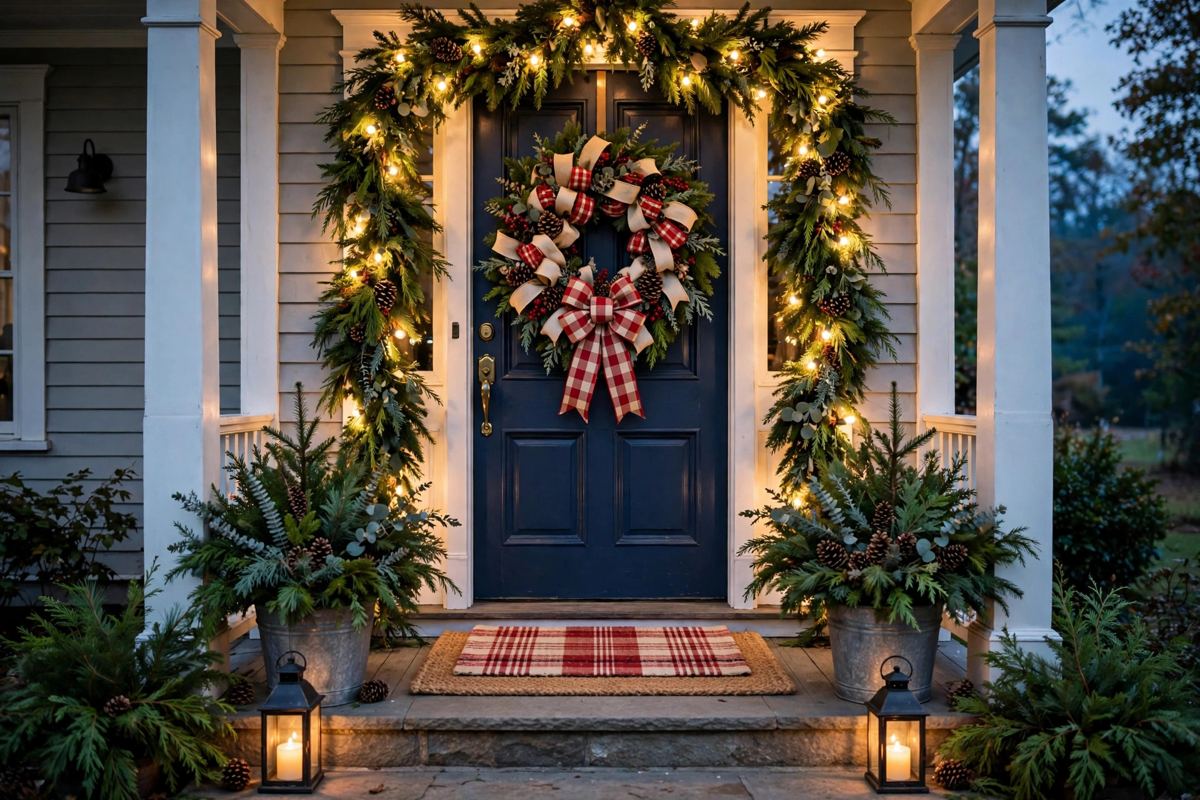
This guide gives you 15 ideas organized by zone — countertops, window, island, and shelves — with real costs, measurements, and a plan you can finish in one weekend. You will learn the 4-zone formula that keeps decor out of your cooking space, how to hang garland where it will not catch on a cabinet door, and how to set up a cocoa bar guests actually use. And because the kitchen opens onto the rest of the house, it pairs with our front porch Christmas decor ideas, so the warm welcome starts at the door and continues right into the room where everyone gathers.
Start With the 4-Zone Kitchen Formula
Divide the kitchen into four zones before you buy anything: the countertop run, the window and sink, the island or table, and the shelves and cabinet tops. Give each zone exactly one decoration job — a vignette, a garland, or a light strand — and leave the cooking zone, the 24 inches beside the stove, completely bare. When a kitchen looks cluttered at Christmas, it is almost always because someone decorated the whole room as one surface instead of four small ones.
Pick one palette and hold it across all four zones. The warm look in this guide is evergreen, warm white lights, natural wood, and cream, with one accent — deep red or burgundy — repeated in the towels, one ribbon, and one bowl of fruit or ornaments. When every zone shares the same palette, a $90 kitchen looks intentional; when each zone has its own color story, even expensive decor looks like a clearance aisle.
Finally, choose your light temperature once and stick to it: warm white, 2700K, everywhere. Mixed light temperatures are the fastest way to make a kitchen feel off at night, and in a room with white cabinets and stainless steel, cool white lights make the whole space feel like a grocery store. One box of warm white fairy lights, bought twice, beats three different sets bought once.
Countertops: 4 Ideas
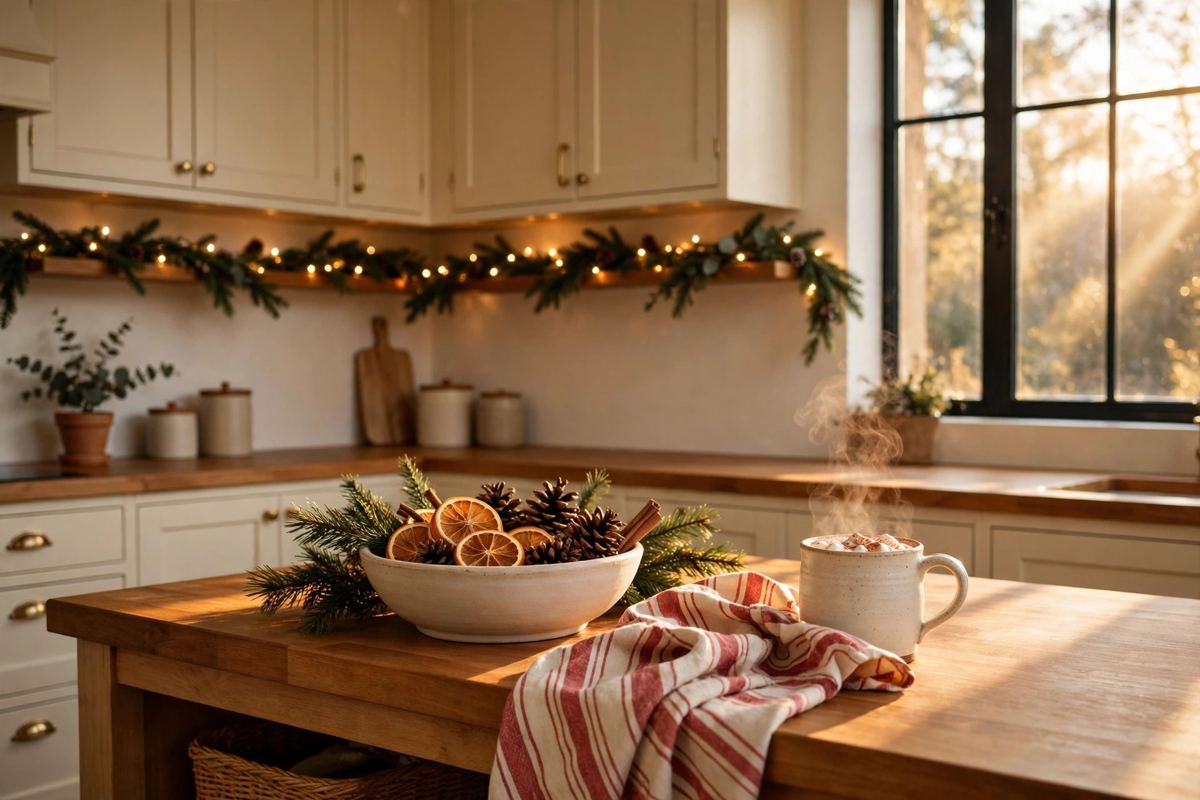
1. The one-bowl vignette. Pick one back corner of the counter — never the stretch beside the stove — and build a single bowl vignette: a wide ceramic bowl filled with pinecones, dried orange slices, and a few sprigs of cedar, with a small candle lantern beside it. That is the whole countertop decoration, and it is enough. Cost: $5 to $10 if you dry oranges yourself (slice thin, bake at 200°F for 2 to 3 hours), $12 to $20 if you buy a pre-made bowl filler bag. Keep the bowl at least 12 inches from any burner.
2. The towel and mitt swap. The cheapest transformation in this guide: swap your everyday hand towels and oven mitts for a red-striped or plaid set, and hang one over the oven handle where it is visible from the doorway. Towels cost $8 to $15 for a set, mitts $6 to $12, and they do double duty — they decorate and they get used every day. Buy a second set if you host often, because a stained Christmas towel on party night defeats the purpose.
3. The cutting-board display. Lean a large wooden cutting board against the backsplash, prop a small framed print or a sprig of greenery in front of it, and set a jar of candy canes or wooden spoons beside it. This uses vertical space, so it costs zero counter depth, and it looks styled rather than stored. It also survives real cooking: when you need the board, you lift it down, use it, and lean it back. Cost: $0 if you already own the board, $15 to $30 for a new one.
4. The tiered tray, done once. A two-tier tray on the counter holds a tiny tree, a candle, a few ornaments, and a small sign — the whole Christmas kitchen in one footprint, about 10 inches across. The rule is one tray per kitchen, not one per counter run, and it lives at the back of the counter, not the middle. Cost: $20 to $35 for the tray, $10 to $15 for the fillers. If you already own a cake stand, use that as the bottom tier and skip the purchase entirely.
The Window & Sink: 3 Ideas
5. The window garland with lights. Run one 6-foot cedar garland along the top of the kitchen window, let the ends drop 8 to 10 inches on each side, and weave a 50-light battery fairy strand through it before you hang it. This is the single highest-impact kitchen decoration, because the window is what you see from the table and from the yard at night. Cost: $15 to $30 for faux garland, $12 to $20 fresh, plus $8 to $12 for battery lights with a timer. Anchor it with two small adhesive hooks rated for outdoor use, so it comes down in January without a mark.
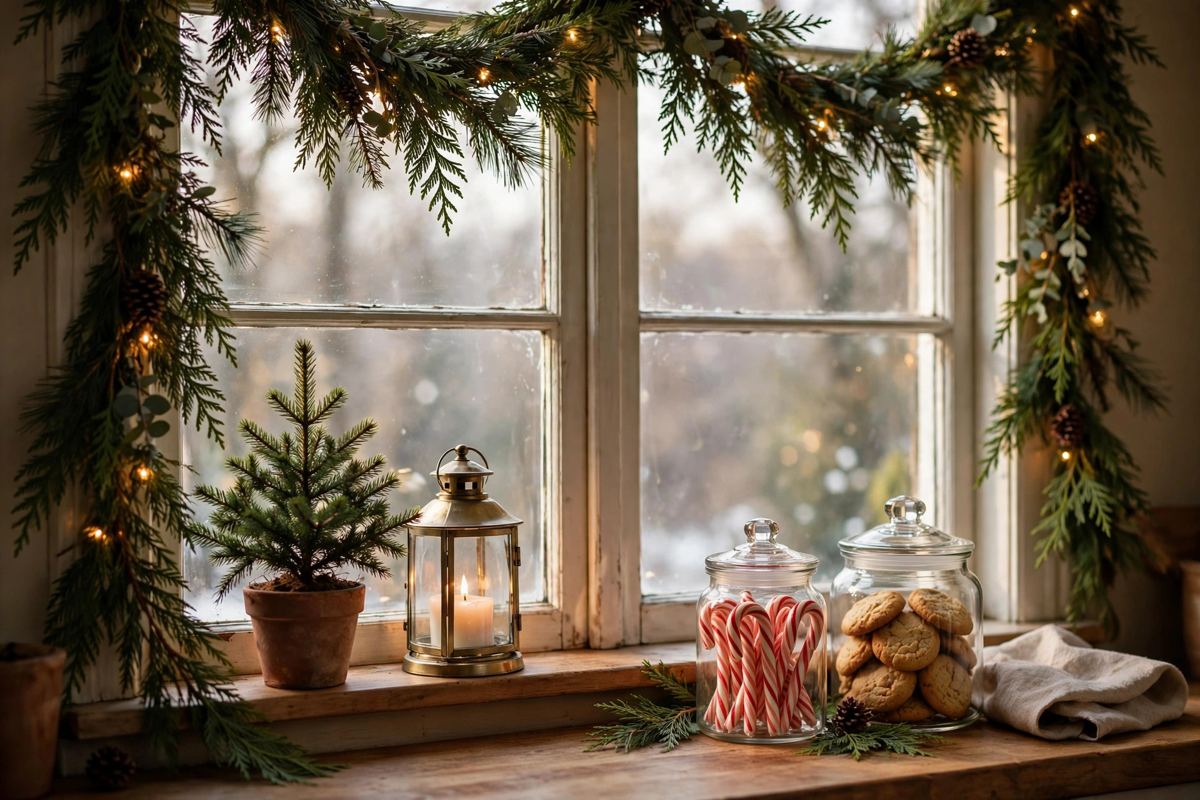
6. The windowsill trio. On the sill itself, group three things of different heights: a small potted evergreen (6 to 8 inches tall), a candle lantern, and a jar of cookies or candy canes. Three is the magic number — two looks sparse, four looks crowded on a standard 36-inch sill. The evergreen costs $8 to $15, the lantern $10 to $20, and the jar is free if you already own one. Keep the candle away from the curtain edge, and use a battery candle if the sill is narrow.
7. The sink-side wreath. Hang a small wreath — 12 to 16 inches, not the 24-inch door size — on the wall above the sink or on the side of a cabinet, where it is visible while you wash up. A mini wreath costs $10 to $18 and lasts the whole season, and it is the decoration you will actually notice daily, because the sink is where you stand. Tie one small bow at the bottom in your accent color, and match it to the towel set so the zone reads as one thought. For the full wreath technique, our Christmas garland ideas guide covers fresh versus faux and hanging without damage.
The Island & Table: 3 Ideas
8. The island runner, not a centerpiece. On an island, a runner does more than a centerpiece and costs less counter space: a red plaid or natural linen runner down the middle, about 12 inches wide, with one low arrangement on top — a wood tray holding three candles of different heights and a few sprigs of greenery. Keep the arrangement under 12 inches tall so people can talk across the island, and keep one end of the island clear for prep. Cost: $12 to $20 for the runner, $15 to $25 for the candles and tray.
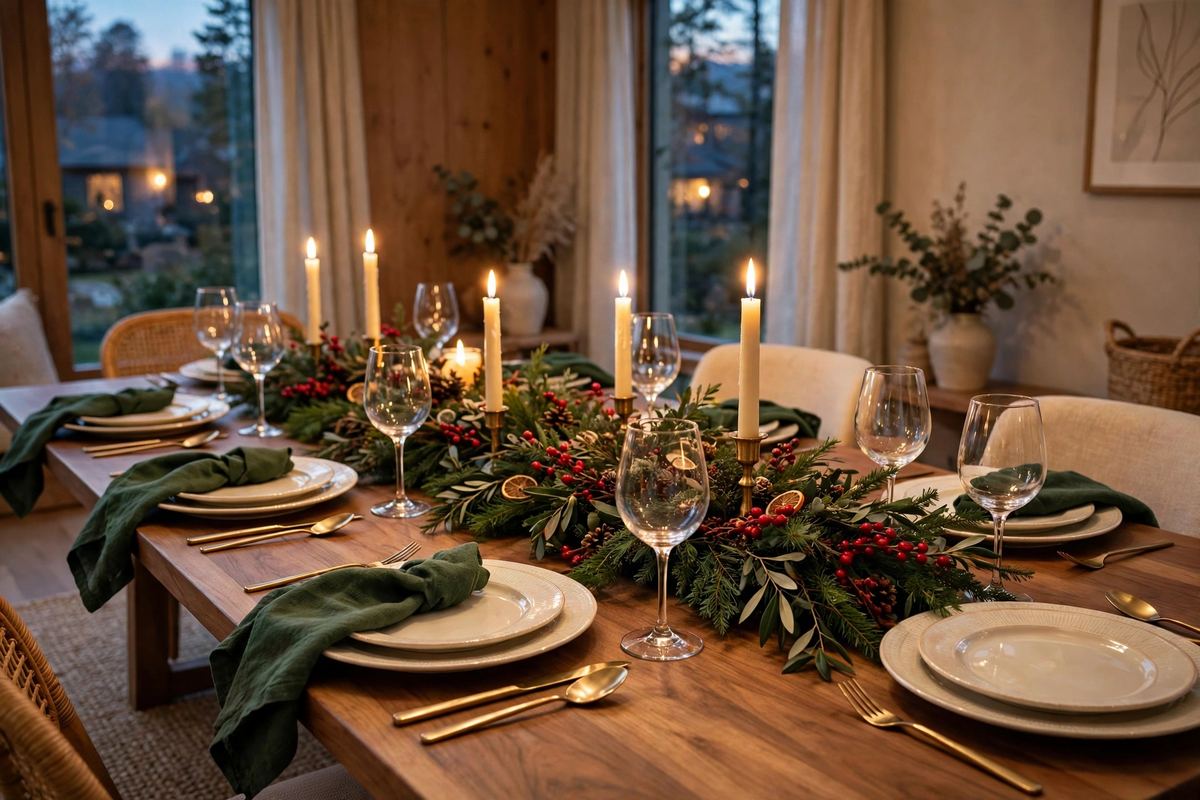
9. The breakfast-table centerpiece. If you eat in the kitchen, the table gets the same treatment at a smaller scale: a short garland runner or a folded plaid cloth, one candle lantern, and a small bowl of clementines or ornaments. The table centerpiece must survive a meal — nothing tall, nothing that sheds needles into the food, and nothing that has to move for every plate. Cedar sheds less than fir, and a tray under the whole arrangement means you lift it off in one motion when dinner is served. Our Christmas tablescape ideas guide scales this up for the dining room when the big dinner moves out of the kitchen.
10. The stool and chair touch. Tie one small sprig of greenery and a ribbon to the back of each bar stool or kitchen chair — a 30-second job per chair that makes the whole eating area feel dressed. Use wired ribbon so the bow holds its shape, and keep the sprig small enough that nobody sits on it. Cost: $0 if you trim from your garland offcuts, $5 to $8 for a bundle of sprigs. This is the detail guests photograph, because it is at eye level when they sit down.
Open Shelves & Cabinets: 3 Ideas
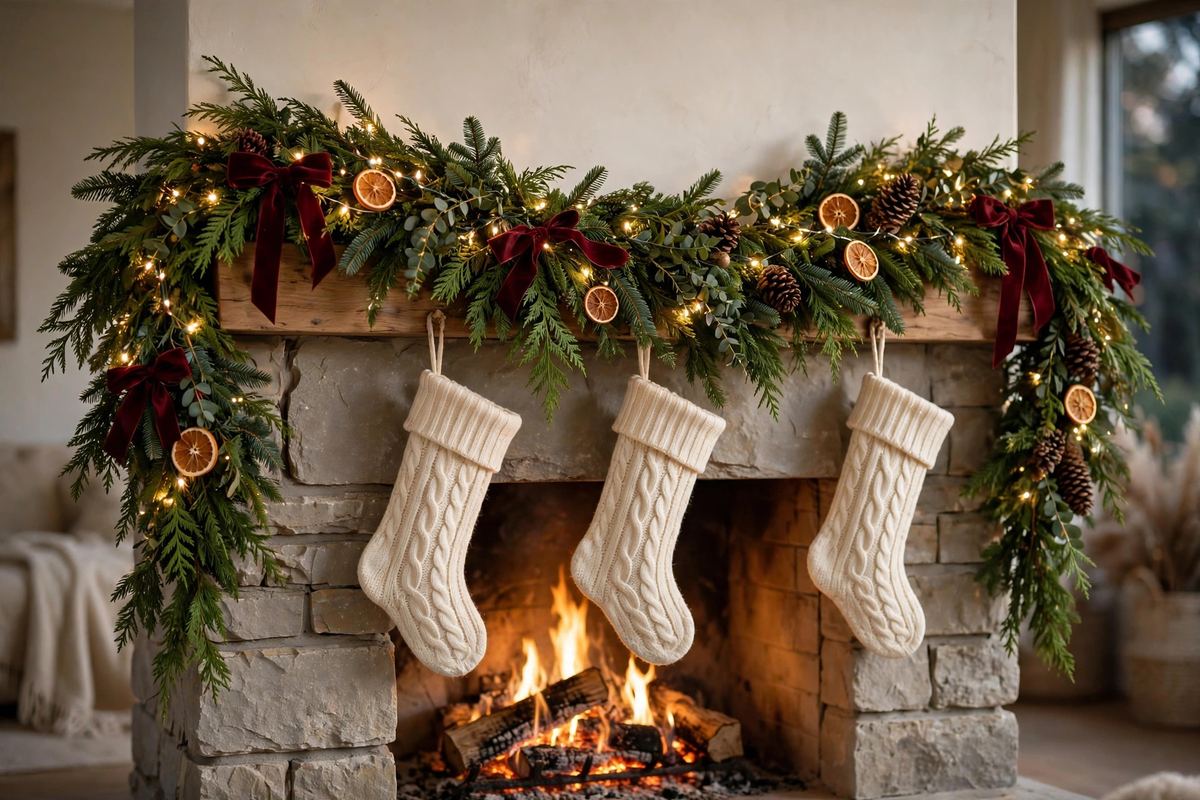
11. The shelf-top garland. Along the top of open shelves or upper cabinets, run one long garland — about 9 feet for a standard 6-foot shelf run, so it can dip and pool at the ends — with a warm white fairy strand woven through. This is the kitchen version of the mantel garland, and it frames the whole room from the doorway. If your cabinets run to the ceiling, skip this and use the window garland instead; garland crammed into a 2-inch gap looks like storage, not decor.
12. The styled shelf, swapped not added. On open shelves, do not add Christmas on top of everything already there — swap three items for three seasonal ones. Replace a plain white bowl with a red one, a everyday mug with a striped one, and one stack of plates with a small evergreen in a pot. The shelf still works as a shelf, it just reads Christmas, and in January you swap back in five minutes. This is the renter-friendly move too: nothing hung, nothing drilled, nothing to repair.
13. The cabinet-door wreath pair. Hang two mini wreaths — one on each of a pair of upper cabinet doors, or one on the pantry door and one on the fridge with a magnetic hook — tied with the same ribbon as the sink wreath. Two matching wreaths read intentional; one random wreath reads forgotten. Cost: $10 to $18 each. Keep them off the doors you open fifty times a day, or they will be on the floor by the second week — the pantry or the least-used cabinet is the right door.
Small Kitchens & Rentals
A small kitchen gets the same formula, shrunk, not skipped. Use the window garland and the towel swap only, plus one bowl vignette if you have a back corner — three zones, not four, and no island runner if the island is your only prep space. The rule is proportion: in a galley kitchen, a 6-foot window garland and a striped towel are already a lot, and adding a tiered tray on top tips it into clutter. Renters, take note: adhesive hooks, magnetic hooks, and freestanding displays leave no marks, so the whole look comes down in January with nothing to repair and no deposit risk.
If you have no window over the sink — a common apartment layout — put the formula on the wall instead: a small wreath above the sink, a garland along the top of the upper cabinets, and the towel swap. The light strand goes around the cabinet tops, not the window you do not have, and a battery strand with a timer means no cord trailing to an outlet. A lit cabinet-top garland does the work of a whole window display at night, and it is the one decoration worth spending more on when space is tight.
Hosting: The Cocoa Bar & Baking Station
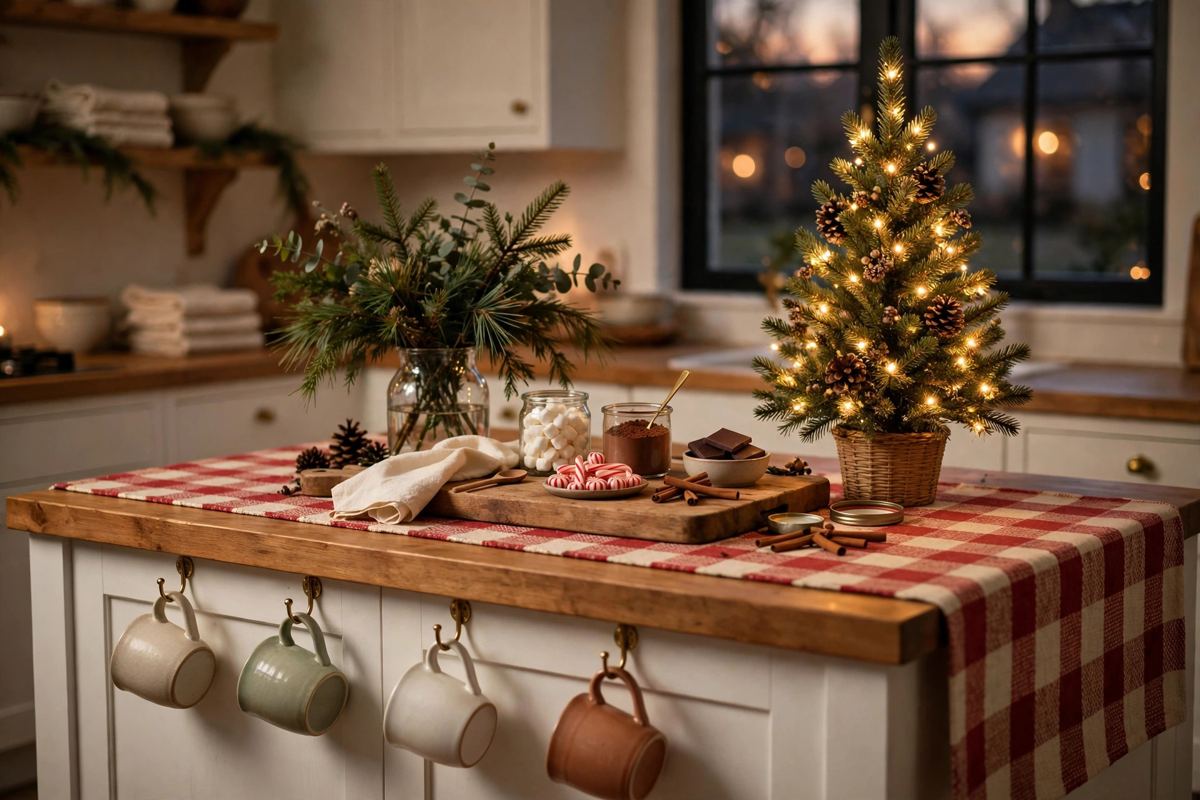
14. The cocoa bar on one tray. Set a wood tray on the island or a side counter with four things: a jar of cocoa mix, a jar of marshmallows, a small pitcher or carafe, and three or four mugs hung from a mug tree or hooks. That is a cocoa bar, and guests will use it without being told — the trick is keeping it to one tray, so it reads as an invitation, not a mess. Cost: $15 to $25 for the jars and tray if you do not own them, plus the cocoa itself. Our Christmas gift basket ideas guide turns this same tray into a hot-cocoa gift basket, if you want the idea to leave the house.
15. The baking station that stays out. If you bake at Christmas, make the baking station part of the decor instead of hiding it: a crock of wooden spoons, a jar of flour and one of sugar with wood scoops, a rolling pin in a tall jar, and a folded striped towel over the oven handle. It looks like a food-magazine kitchen, it is all stuff you actually use, and it never has to be cleared away for a photo. Keep the flour and sugar jars at the back of the counter, away from the sink splash zone, and the station works all month.
When the big dinner moves to the dining room, the kitchen's job is done — it fed everyone, it looked the part, and nothing had to be moved for the meal. That is the test of good kitchen decor: it survives the cooking, the hosting, and the cleanup, and it still looks good on December 26. For edible gifts to go with the baking station, our DIY Christmas gifts under $25 guide uses the same one-afternoon, low-cost approach for simmer-pot kits and cookie gifts.
The One-Weekend Plan & Real Costs
Saturday morning, buy or gather: one window garland, one shelf garland, two light strands, a towel and mitt set, one bowl vignette, and the cocoa-bar jars. Saturday afternoon, hang the window garland and the shelf garland, weave the lights through first, and set the bowl vignette and the tiered tray. Sunday morning, swap the towels, set the cocoa bar tray, tie the chair sprigs, and step back to the doorway at dusk to check the lights. Total time: 2 to 3 hours spread over two days, and most of it is hanging and stepping back, not building.
On cost, a full kitchen using faux garland — the buy-once version — runs about $90 to $150: garlands $30 to $50, lights $16 to $24, towels and mitts $14 to $27, bowl vignette $12 to $20, cocoa-bar jars and tray $15 to $25, mini wreaths $20 to $36. The fresh-greenery version runs $60 to $100 the first year, but you buy the garland again every year, so faux wins by year two. Either way, the towel swap and the window garland are the best value in the kitchen: under $45 combined, used every day, and they make the whole room feel finished even before anything else goes up.
When the season ends, take it down in reverse: lights first, then garland, then wreaths, then the tray. Store faux garland in a bag, not a box that crushes it, and label the bag with the length — next year you will thank yourself. Fresh greenery goes in the yard waste, the towels go in the wash, and the cocoa-bar jars go back to everyday pantry duty. For the room everyone gathers in next, our Christmas garland ideas guide carries the same warm palette onto the mantel and staircase.
Mistakes to Avoid
- Decorating the cooking zone. The 24 inches beside the stove stay bare. A vignette there is not festive — it is in the way, and it is a fire risk.
- Mixed light temperatures. Warm white window lights plus cool white shelf lights look patched together at night. Buy one color temperature, 2700K, for everything.
- A centerpiece taller than conversation. Anything over 12 inches on the island blocks faces across the table. Keep island arrangements low.
- Greenery that sheds into food. Fir sheds; cedar sheds less. Never put a shedding garland directly above a prep surface or an uncovered dish.
- Real candles near curtains or the stove. Battery candles with timers glow all evening, every evening, and never drip wax near a burner.
- Decorating every surface. Four zones, one job each. A kitchen decorated edge to edge is a kitchen you cannot cook in.
- Forgetting the doorway view. Step back to the doorway at dusk and look in. If the first thing you see is clutter, not glow, remove one thing.