Your front porch is the one part of your Christmas decorating that every single visitor sees — and the one most people rush. A wreath slapped on the door, a string of lights that half works, and a doormat from three years ago. These front porch Christmas decor ideas fix that, because the porch is not a separate decoration: it is the opening scene of your whole house at Christmas, and it sets what guests expect when they step inside.
This guide gives you 15 outdoor Christmas decor ideas built around a simple formula, with real costs, measurements, and a plan you can finish in one weekend. You will learn how to frame the door so it reads from the street, how to layer a doormat like the pros do, which planters survive a freeze, and how to light the whole porch without a single tangled cord showing. If you are starting inside the house too, our Christmas garland ideas guide covers the mantel and staircase in the same warm style, so the inside and outside feel like one home.
Start With the 5-Piece Porch Formula
Every great porch in this guide uses the same five pieces: a door frame (garland arch or swag), a wreath, a layered doormat, two matching planters, and lanterns. That is it. When a porch looks cluttered, it is almost always because someone added a sixth, seventh, and eighth idea — a porch sign, a sled, a reindeer, a light-up snowman — on top of a formula that was already complete. Start with the five, step back to the street, and only add one extra piece if something still looks empty from 20 feet away.
Scale matters more than quantity. A standard 36-inch door needs a wreath 24 to 28 inches across — smaller reads lost, larger blocks the peephole and the handle. Planters should reach about knee height once planted, roughly 20 to 24 inches tall, so they frame the door instead of hiding behind the steps. And symmetry is your friend outdoors: two matching planters and two matching lanterns look intentional, while two different ones look like leftovers. If you already own one good planter, buy its twin before you buy anything new.
Pick one color story and hold it across all five pieces. The warm look this guide uses is evergreen, warm white lights, natural wood and galvanized metal, with one accent — burgundy, plaid, or deep red — repeated in the wreath bow, the doormat layer, and one blanket or ribbon. When every piece shares the same palette, a $120 porch looks like a $400 porch, because nothing fights for attention.
Door Arch, Wreath & Garland: 4 Ideas
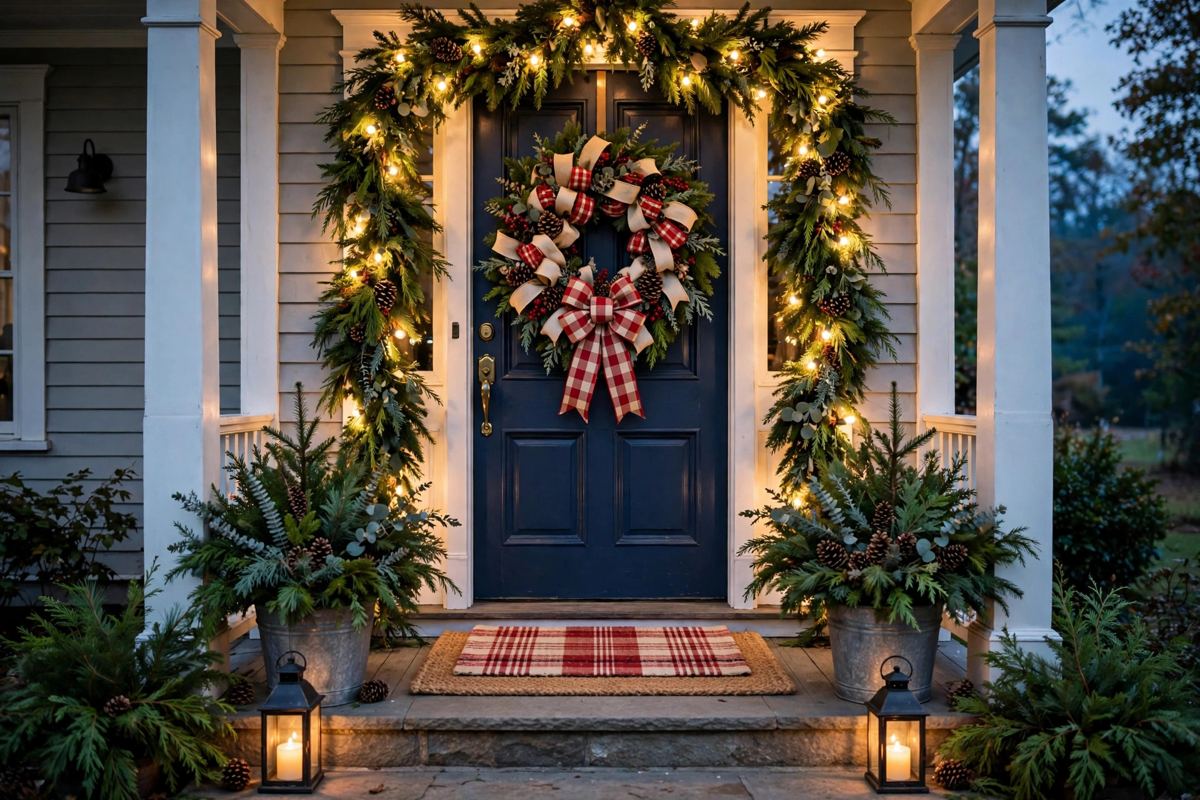
1. The full door arch. Run one long garland up one side of the door, across the top, and down the other side — a full arch, not just a top swag. A standard door with 8-foot ceilings needs 16 to 18 feet of garland for a full arch with side drops. Anchor it at the top corners and the midpoint of each side so wind cannot pull it loose, and weave the lights through on the ground before you hang it. This is the single highest-impact outdoor decoration you can do, because every visitor walks through it. Cost: $50 to $90 for two 9-foot faux garlands, or $40 to $70 fresh, plus one 100-light strand ($8 to $15).
2. The oversized wreath, hung high. Hang a 28-inch wreath at eye level or slightly above — about 60 inches from the porch floor to the wreath center — and tie one big bow at the bottom, not the top, so it reads from the street. A fresh fir wreath costs $25 to $45 and lasts 3 to 4 weeks outdoors in the cold; a good faux wreath costs $40 to $80 and lasts years. If your door has a storm door, hang the wreath on the storm door or on the house wall beside it — a wreath trapped between two doors fades fast and rattles every time the door closes.
3. The double-door frame. On a double door or a door with sidelights, run the garland across the full width and hang one wreath on each door, or one oversized wreath centered on the pair. Keep the side drops shorter than on a single door, or the garland will brush everyone who enters. For the full garland technique — fresh versus faux, swag depths, and hanging without damage — our Christmas garland ideas guide covers it step by step.
4. The doorway that matches the mantel. Use the same greenery, ribbon, and accent color indoors and out — cedar garland and a burgundy velvet bow on the door, cedar garland and burgundy velvet bows on the mantel — and the house feels designed instead of decorated in two separate trips. Our velvet bow Christmas decor guide shows how one ribbon, bought once, ties the whole house together, and our Victorian Christmas mantel ideas guide carries the same warm palette indoors.
Lanterns & Layered Doormats: 3 Ideas
5. The lantern pair on the steps. Put one lantern on each side of the bottom step, or one on each side of the door if you have no steps, and use the same lantern in both spots. Black metal lanterns with a battery pillar candle inside cost $15 to $30 each, and the timer setting — on at dusk, off after 6 hours — means you never touch them again all season. Real candles blow out outdoors and drip wax in the wind; battery candles glow steadily and are the one place where fake beats real, no contest.
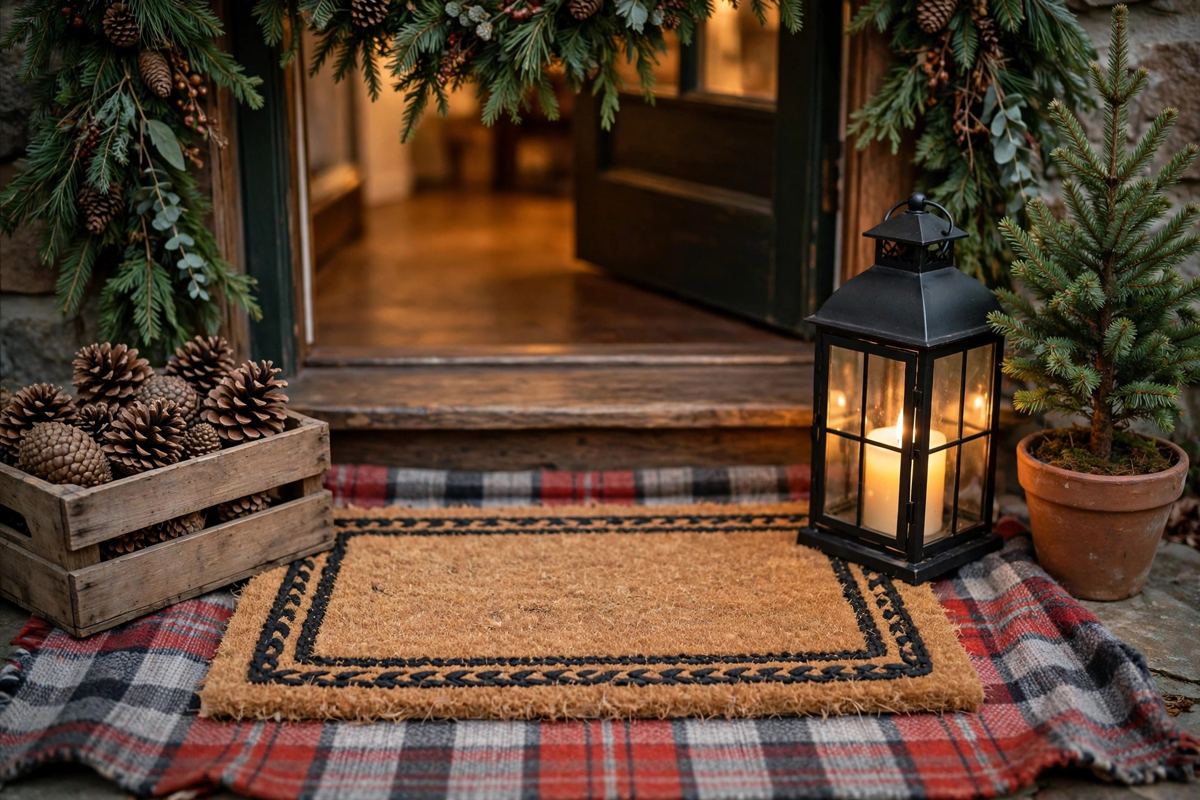
6. The layered doormat. This is the cheapest upgrade in the whole guide, and it changes the porch more than anything under $30 should. Lay a large flat rug — plaid, buffalo check, or plain natural fiber, about 2 by 3 feet — on the porch floor, then put a smaller coir doormat on top of it, centered. The bottom layer adds color and size, the top layer does the actual wiping, and together they look like a styled entry instead of a single mat lost on a big porch. Cost: $12 to $20 for the base rug, $10 to $18 for the coir mat. Swap only the top mat when it wears out; the base rug lasts years.
7. The lantern cluster by the door. If the steps are too narrow for a pair, group three lanterns of different heights — tall, medium, short — in one corner by the door, with a small evergreen sprig tucked behind them. The cluster reads as one arrangement instead of three stray objects, and it gives you a place to use the lantern you already own alongside two new ones. Keep the tallest lantern under 18 inches, or it will block the door handle swing.
Planters That Survive Winter: 3 Ideas
8. The evergreen planter, built like a bouquet. Fill each planter with a thriller, a filler, and a spiller, the same way you would a summer pot — only winter-proof. The thriller is a small upright evergreen or a bundle of tall branches in the center; the filler is shorter cedar, pine, and pinecones packed around it; the spiller is trailing cedar or ivy over the edge. A pair of planters built this way costs $30 to $60 total if you cut branches yourself, $60 to $120 if you buy pre-made inserts. Water once at planting, then leave them alone — frozen soil needs no watering, and overwatering is what cracks pots.
9. The porch tree in a basket. A small potted evergreen — 3 to 4 feet tall — in a woven basket or galvanized bucket, with one strand of 50 warm white lights, is the easiest porch tree there is. It needs no ornaments to look finished, it survives the whole season outdoors, and after Christmas you can plant it or keep it in the pot for next year. Cost: $25 to $45 for the tree, $10 to $20 for the basket, $8 to $12 for the lights. If you want a second tree, buy the same size — two matching porch trees flanking the door beat one large tree and one small one every time.
10. The frost-proof planter rule. Before you buy any planter, check the material: glazed ceramic and thin terracotta crack in a freeze, because trapped water expands. Use wood, metal, fiberglass, or thick frost-proof stone outdoors, and drill a drainage hole if there is not one — standing water is what cracks pots, not cold alone. If you already own a ceramic planter you love, use it as a cachepot: put a plastic nursery pot inside it, and bring the ceramic shell indoors on nights below freezing.
Outdoor Lights Without the Tangled Mess: 2 Ideas
11. One color temperature, everywhere. Buy all your outdoor lights in warm white, and check the box for the same color temperature — 2700K is the cozy standard. Mixing warm white garland lights with cool white railing lights is the most common reason a porch looks off at night, even when everything is technically lit. Count your strands before you buy: door arch (100 lights), each planter or porch tree (50 lights), railing (one strand per 10 feet). A standard porch needs 250 to 300 lights total, and one outdoor-rated timer ($12 to $18) should run all of them.
12. Hide the cords, or there are no cords. Run light cords along the back of the garland, down the least visible side of the door frame, and under the doormat layer to the outlet — never across the walkway, where they trip guests and look messy. Where no outlet reaches, battery lights with timers are the answer for garland and wreaths, and solar lights work on a south-facing porch but fade fast on a shaded one. If you are also decorating the yard, run one outdoor extension cord from the porch outlet and branch everything from it, instead of running three cords from three windows.
Porch Seating & Cozy Corners: 3 Ideas
13. The rocking chair with a plaid blanket. One wooden rocking chair with a folded red plaid blanket over the arm turns a porch from a walkway into a place — and it is the seat guests photograph. The blanket is the whole decoration: it adds the accent color, it suggests someone actually sits here, and it costs $15 to $25. Bring the blanket in before rain or snow, or it will smell damp for the rest of the season. If you have two chairs, match the blankets; two different blankets look like laundry, not decor.
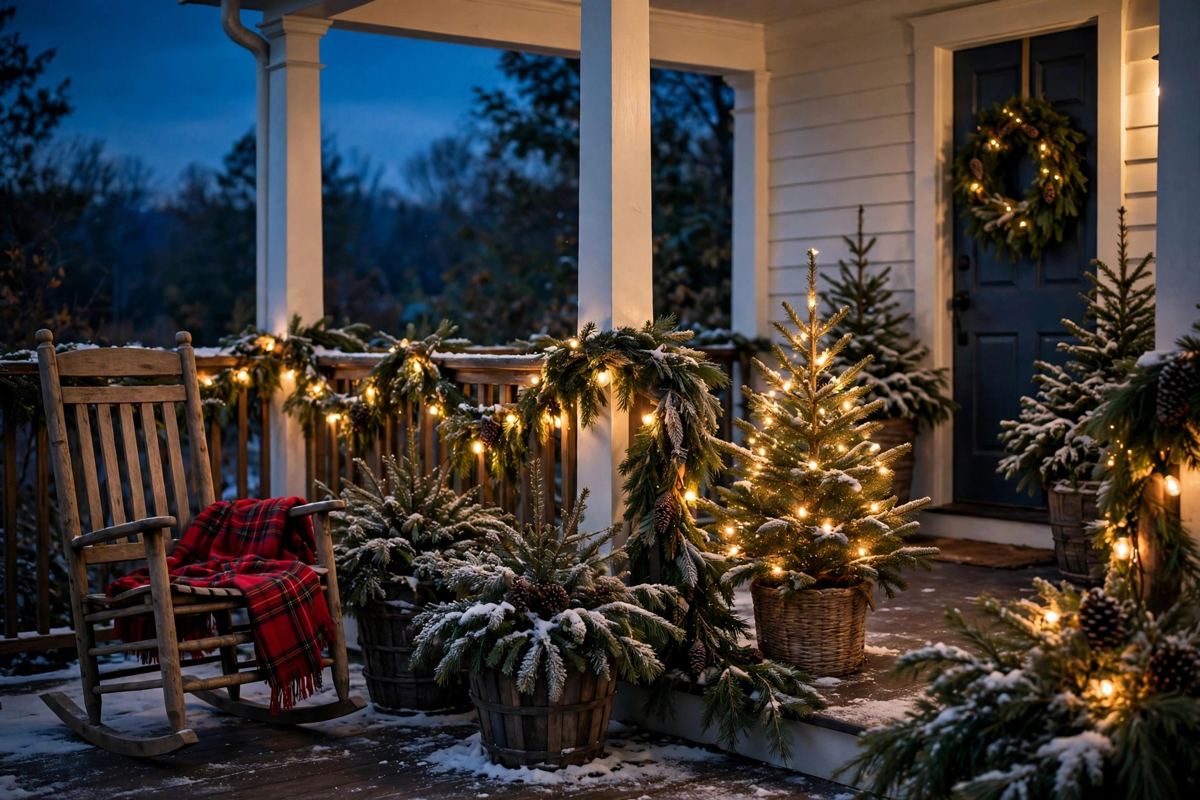
14. The railing garland with a swag. On a porch with a railing, drape garland along the top rail in loose swags — one dip per two or three balusters — and tie a small bow at each low point. This is the porch version of the staircase garland, and it frames the whole porch from the street instead of just the door. A railing needs about 1.5 times its length in garland once swags are factored in, so measure the rail, multiply by 1.5, and buy that length. Battery lights woven through before hanging keep the railing glowing without a cord run.
15. The porch vignette in one corner. If your porch is large, claim one corner as a vignette: a small bench or crate, a lantern cluster, a basket of pinecones, and one evergreen branch in a tall vase. The vignette gives the eye a place to land, and it is where you put the extra piece — the vintage sled, the old skates, the wooden star — without letting it take over the whole porch. One vignette, not three, and keep the walkway clear: guests should never have to step around decor to reach your door.
Small Porches & Apartments
A small porch or an apartment landing gets the same formula, shrunk, not skipped. Use a top door swag instead of a full arch — one 6-foot garland across the top of the door with side drops of 12 inches, not full-length drops. Use one planter instead of two, one lantern instead of a pair, and a single-layer doormat if a layered one eats the whole landing. The rule is proportion: on a 4-foot-wide landing, a 28-inch wreath and a knee-high planter are already a lot, and adding a second of each tips it into clutter. Renters, take note: adhesive hooks rated for outdoor use and freestanding planters leave no marks, so the whole look comes down in January with nothing to repair.
If you have no porch at all — just a door that opens onto a shared hall or a sidewalk — put the formula on the door itself: a wreath, a door swag, and a doormat are the whole porch, and they are enough. A lit wreath with battery lights does the work of a whole porch display from the street, and it is the one decoration worth spending more on when space is tight.
The One-Weekend Plan & Real Costs
Saturday morning, buy or gather: two garlands, one wreath, two planters or inserts, two lanterns, one base rug and one coir mat, and three light strands. Saturday afternoon, hang the garland arch and the wreath, weave the lights through first, and set the planters. Sunday morning, layer the doormat, place the lanterns, add the blanket to the chair, and step back to the street at dusk to check the lights. Total time: 3 to 4 hours spread over two days, and most of it is hanging and stepping back, not building.
On cost, a full porch using faux garland and wreath — the buy-once version — runs about $180 to $280: garlands $50 to $90, wreath $40 to $80, planters $30 to $60, lanterns $30 to $60, doormat layers $22 to $38, lights $25 to $40. The fresh-greenery version runs $120 to $200 the first year, but you buy the garland and wreath again every year, so faux wins by year two. Either way, the doormat layers and the lanterns are the best value on the porch: under $70 combined, used every day, and they make the whole entry look finished even before the garland goes up.
When the season ends, take it down in reverse: lights first, then garland, then wreath, then planters. Store faux garland in a bag, not a box that crushes it, and label the bag with the length — next year you will thank yourself. Fresh greenery goes in the yard waste, planters stay out with their soil in them, and lanterns come inside so the glass does not crack in a hard freeze. For handmade touches to go with the porch, our DIY Christmas gifts under $25 guide uses the same low-cost, one-afternoon approach for pinecone and evergreen projects.
Mistakes to Avoid
- Too many ideas on one porch. The five-piece formula is complete. A porch sign, a sled, a reindeer, and an inflatable on top of it do not add Christmas — they add clutter.
- Mismatched light colors. Warm white garland lights plus cool white railing lights look patched together at night. Buy one color temperature, 2700K, for everything.
- A wreath that is too small. A 16-inch wreath on a 36-inch door reads lost from the street. Go 24 to 28 inches, and hang it at eye level.
- Buying exactly the span length of garland. A door arch needs 16 to 18 feet for a standard door, not 6. Buy 25 to 30 percent more than any span, every time.
- Real candles outdoors. They blow out, drip wax, and go out in the first gust. Battery candles with timers glow all evening, every evening.
- Ceramic planters left out in a freeze. Trapped water cracks them. Use frost-proof pots outdoors, or bring ceramic shells inside on freezing nights.
- Decor blocking the walkway. Guests should never step around decor to reach the door. Keep the path clear, and put the vignette in a corner.