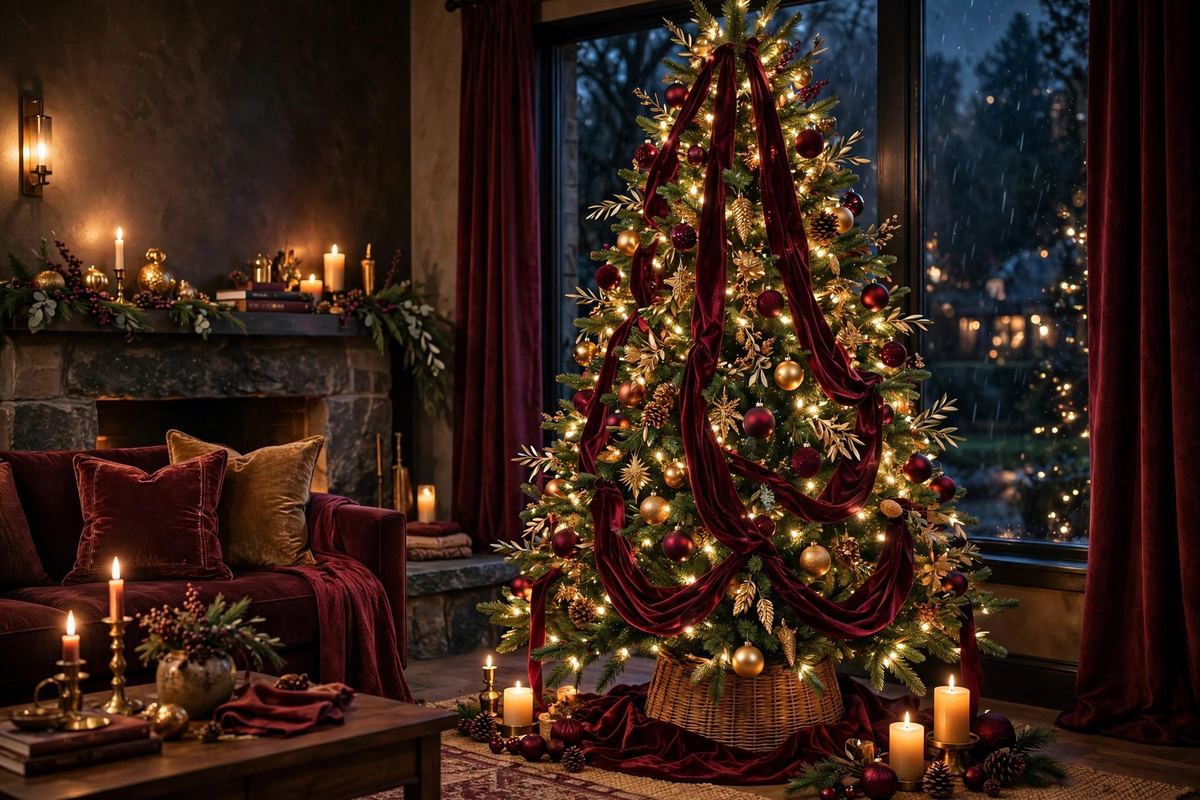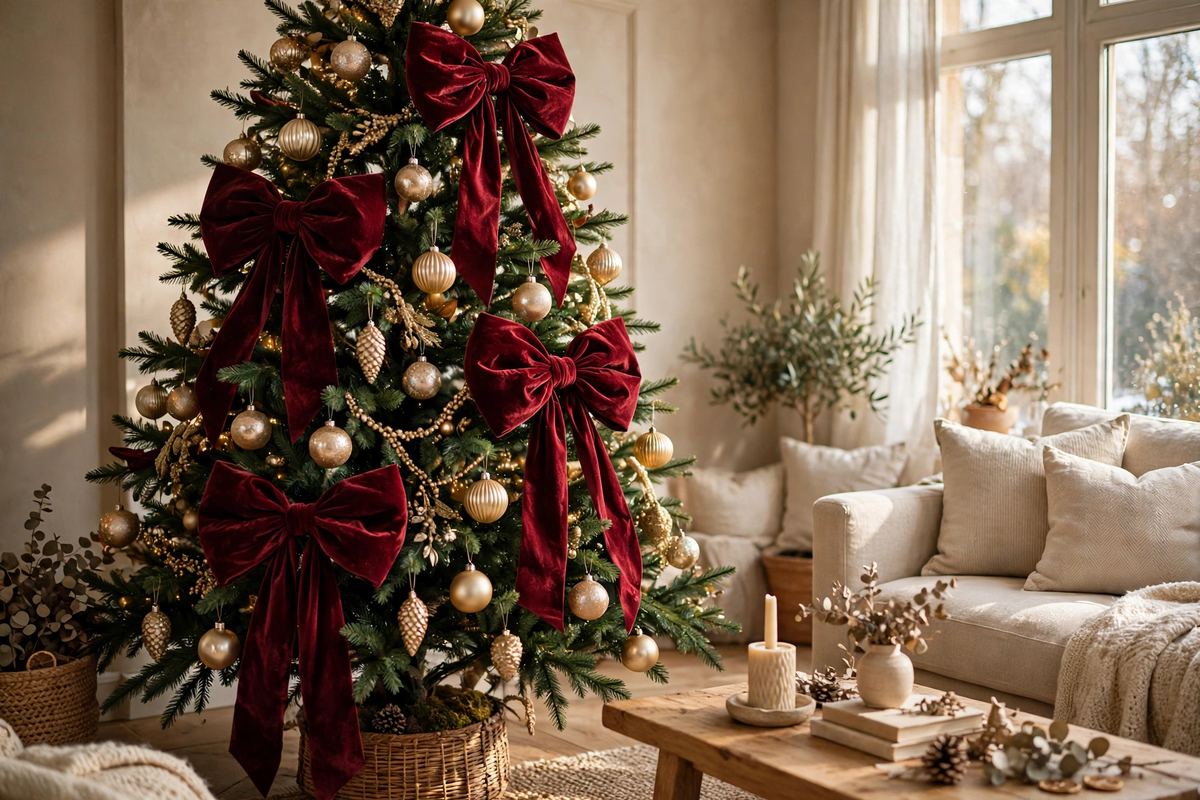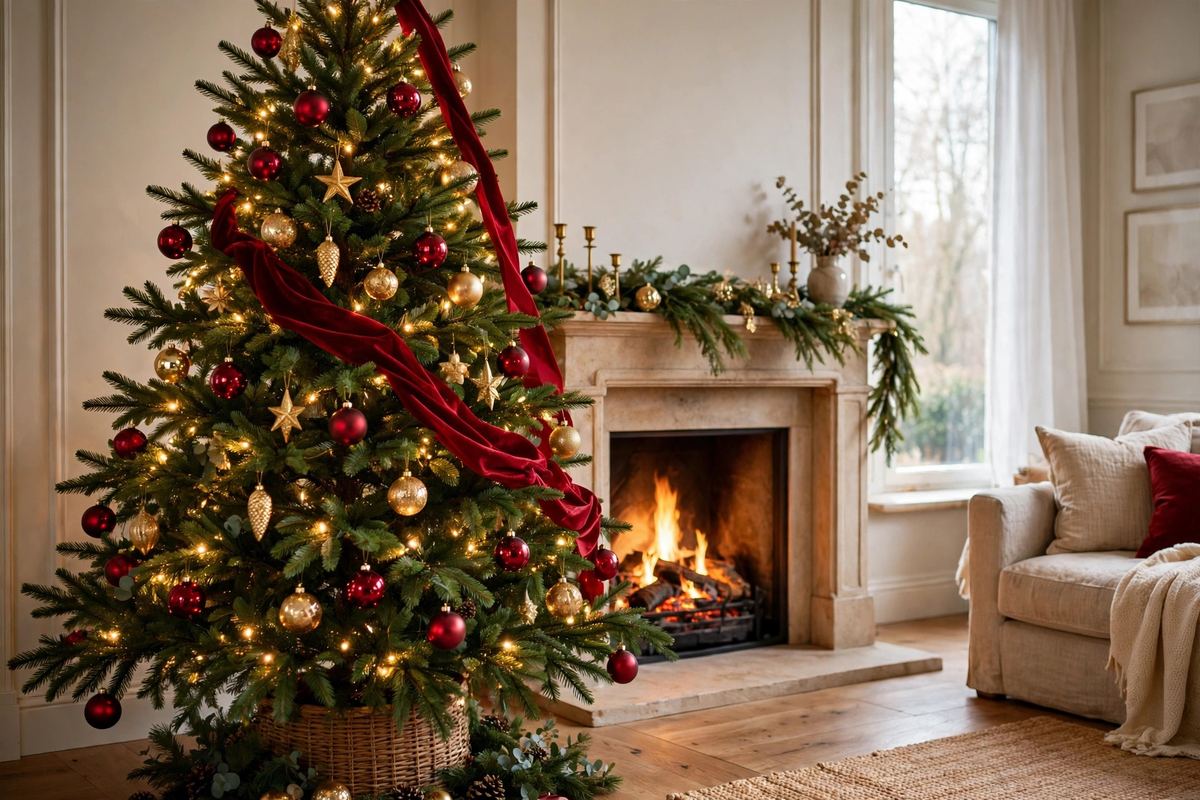
These red Christmas tree decor ideas are not just a mood board — they are a real step-by-step plan. A red Christmas tree is the main character of any holiday room: deep cranberry baubles, warm gold accents, velvet ribbon, and a wash of fairy lights. Get the details right and it is the tree your guests photograph before they even say hello.
In this guide, I am sharing nine styling tips I have tested in real living rooms — the exact ornament formula designers use, the ribbon trick that makes a tree look twice as full, and the five mistakes that turn this classic palette cheap. Everything works on the tree you already own, and the whole look costs less than one fancy dinner out.
Why Red Is the Christmas Color of 2026
Red never fully left, but 2026 gave it a promotion. Searches for red Christmas tree ideas have roughly doubled since spring, and the shade doing the heavy lifting is not the fire-engine red of the nineties — it is burgundy, 2026's deeper, softer, more expensive-looking red. Think cranberry, garnet, and oxblood rather than primary red.
Red works so well this season because it sits at the intersection of nostalgia and warmth. It reads "celebration" instantly, it glows beautifully under warm lighting, and it pairs with the warm wood tones and brass that are already all over 2026 interiors. If you love the moodier side of this palette, our red velvet Christmas decor guide takes the burgundy-and-gold story through the whole house.
Pick Your Red: The Shades That Actually Work
Here is the rule that separates a designer tree from a discount-store tree: two shades of red, maximum. Pick one deep base red (cranberry or burgundy) for about 70 percent of your red ornaments, and one slightly brighter classic red for the remaining 30 percent. Anything more, and the eye cannot tell what it is looking at.
Metallic red ornaments can read cheap fast — if you use them, pair each metallic with a matte red nearby, which instantly makes both look richer. Before you commit, hold your ornaments next to the tree in evening light, because reds shift dramatically under warm bulbs. The burgundy velvet-finish ornaments are the single most 2026 purchase you can make for this look.
The 3-Layer Ornament Formula Designers Use
Amateur trees hang everything on the surface. Designer trees work in three layers, and this is the part that makes the biggest visual difference for the least money.
Layer one goes deep inside the tree: hang 20 to 24 matte gold or bronze baubles in two sizes directly on inner branches, where they catch the lights and give the tree shadow and depth. Layer two is the mid-branch red: your red baubles in graduated sizes (3-inch and 4-inch), mixed roughly 60 percent matte and 40 percent glossy, spaced so no two same-finish ornaments touch. Layer three is the feature pieces at the branch tips — gold filigree baubles, a few glass finials, and pinecones you spray-painted gold the night before.
For quantity, plan 8 to 10 ornaments per foot of tree height. A 7.5-foot tree needs 60 to 80 ornaments total, split about 60 percent red and 40 percent gold or champagne. Hang your heaviest pieces on the sturdiest inner branches — a glass finial dangling off a branch tip is how ornaments end up in pieces by December 26.
Ribbon, Bows, and the 2026 Bow-Topper Rule
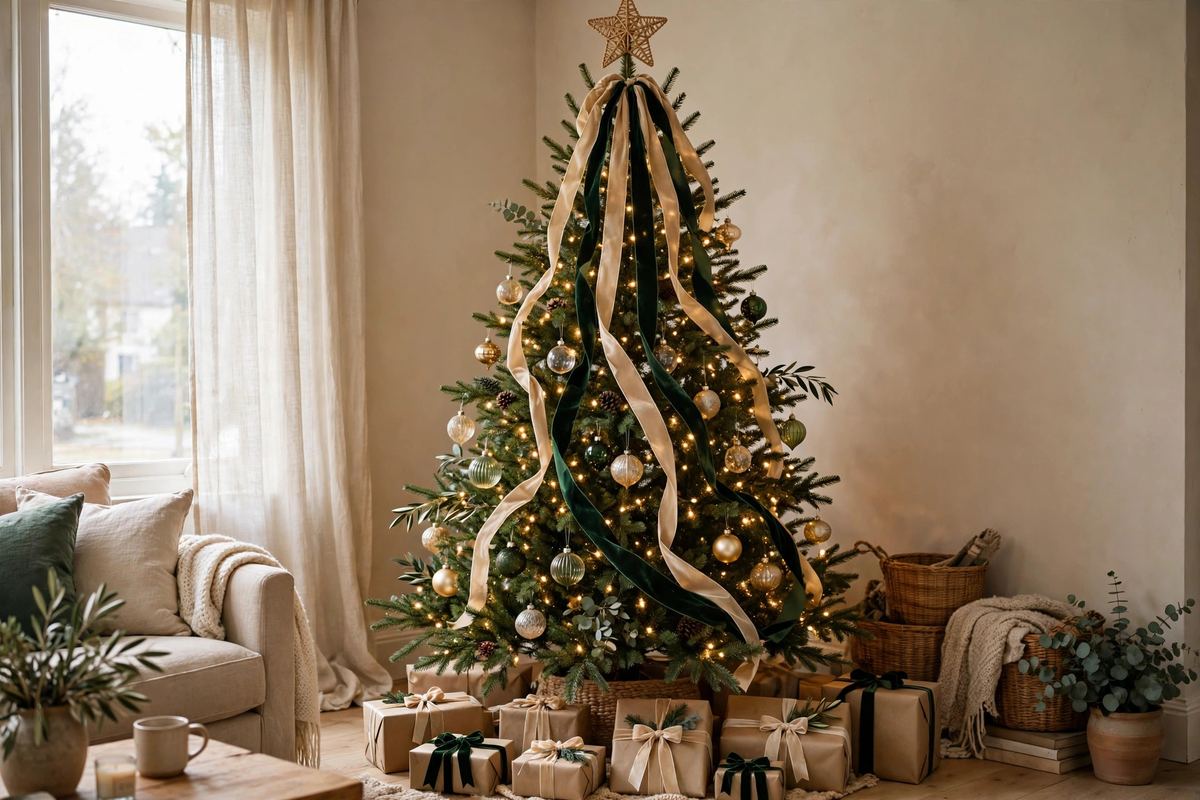
Ribbon is the single fastest way to make a red tree look designed rather than decorated — but only if you weave it, never wrap it. Cut 2.5-inch wired velvet ribbon into 3 to 4-foot strips (you will need about five or six strips for a 7.5-foot tree). Tuck the top of each strip into the upper third of the tree, then let it cascade down through the branches at a slight diagonal, tucking and releasing it every 12 inches so it dives in and out of the greenery. Five minutes per strip, and the tree instantly looks twice as full.
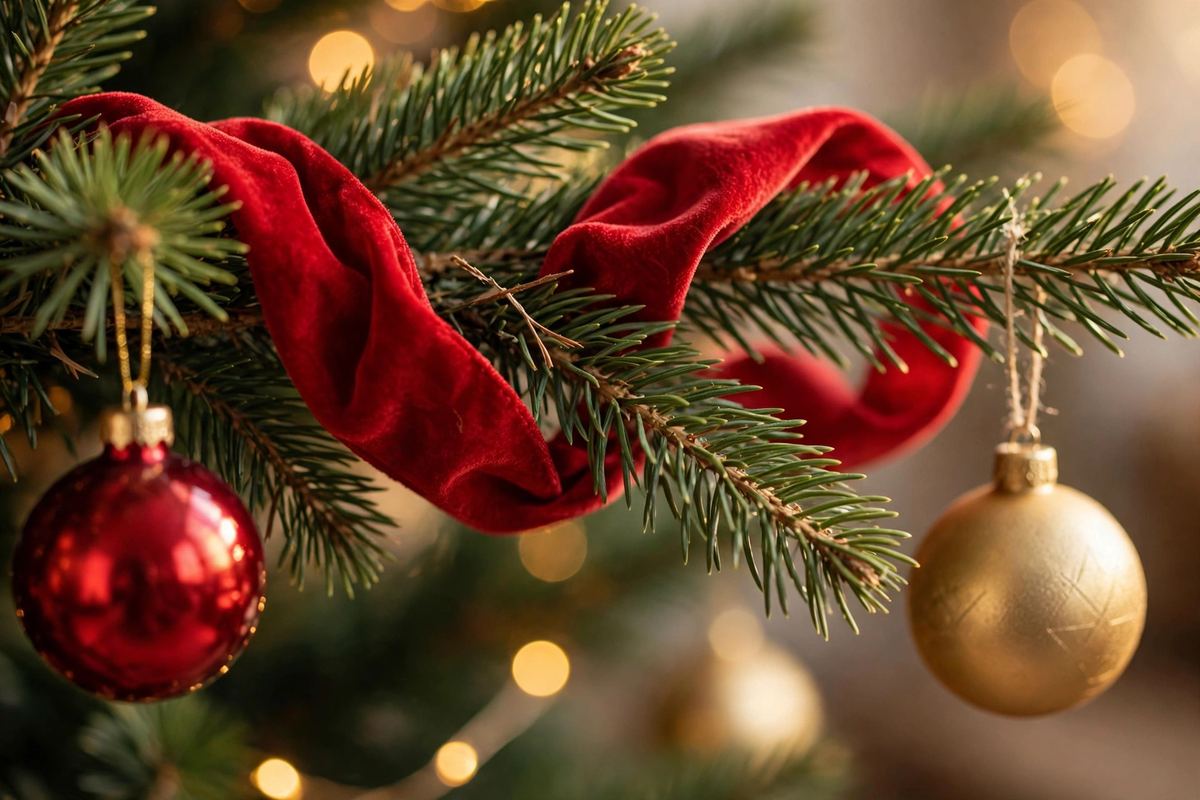
Horizontal wrapping is what gives ribbon a barber-pole look, so resist the urge. If you want the full technique library, our Christmas tree ribbon ideas guide walks through seven designer styles with a yardage chart for any tree size.
And here is the 2026 rule: the tree does not end in a star anymore — it ends in a bow. Tie one oversized burgundy velvet bow with long trailing tails and wire it at the crown where a topper would sit. It takes two minutes, reads softer and more current than anything spiky, and pairs perfectly with the ribbon already woven below. The full how-to lives in our velvet bow Christmas decor tutorial.
Lights and Garlands: The Warm Glow Layer
Red drinks light, so the lights do real work on this tree. Use warm white LEDs only — 2700 to 3000 Kelvin — because cool white flattens red and makes the whole tree look plasticky. The math: roughly 100 bulbs per foot of tree, so a 7.5-foot tree wants 700 to 800 bulbs. String them before a single ornament goes on, working top to bottom, and do two passes — one deep inside the branches, one at the outer edges — so the tree glows from within instead of sparkling only on the surface.
After lights, tuck in fresh or faux cedar and eucalyptus sprigs between branches. They fill gaps for free, add a real evergreen scent, and that touch of natural green makes the reds look richer by contrast. A strand of wood or gold bead garland is the optional finishing layer — one strand, draped loosely, is plenty.
Do Not Skip the Base: Skirts, Collars, and Presents
An exposed metal tree stand is the fastest way to undo everything above it. You have three good options: a rich red velvet skirt with a subtle pattern (the classic choice), a woven basket collar that the tree drops straight into (the current favorite — it reads rustic and hides the stand completely), or a tall galvanized collar for a farmhouse look. A thrifted basket with the bottom cut out costs about five dollars and looks like a prop stylist found it.
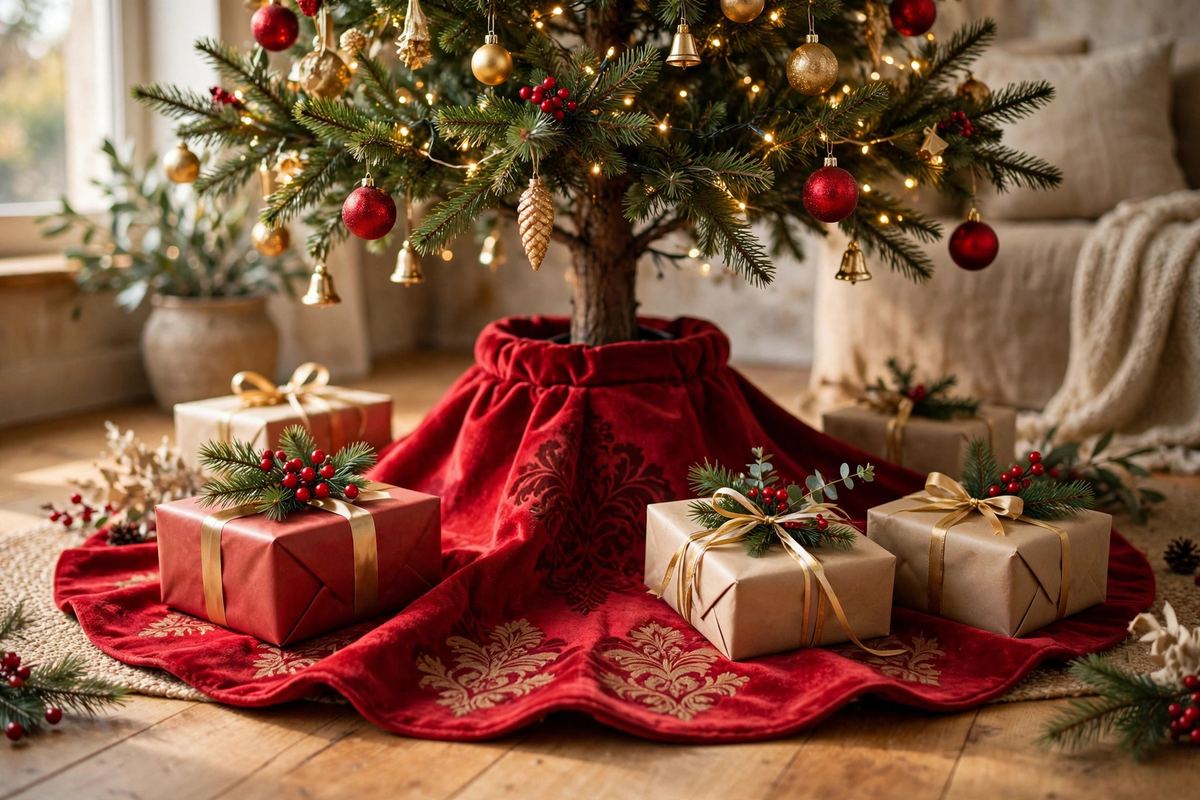
Then style the base like a still life: wrap presents in a tight palette — red paper, kraft paper, and gold ribbon, nothing else — and tuck a few pine sprigs and berry picks around them. Odd numbers of boxes photograph best, and a couple of gifts standing upright at the back add height. This one corner of styling takes ten minutes and it is what people notice in photos.
The $60 Red-and-Gold Tree: Real Budget Math
You do not need a new ornament collection for this look. Here is the actual math for a full 7.5-foot red-and-gold tree, assuming you own the lights and the tree itself: a 24-pack of shatterproof red and gold baubles (about $18), two rolls of wired burgundy velvet ribbon (about $12), one can of gold spray paint for pinecones and thrifted baubles (about $4), a thrifted basket for the collar (about $5), and a DIY velvet bow topper made from leftover ribbon (free). That is $39 — the rest of the ornaments come from the box you already own.
Working with a slim tree in a small apartment? The same formula scales down perfectly — see our pencil Christmas tree ideas for decorating skinny branches so they still look full.
5 Mistakes That Make a Red Tree Look Cheap
One: too many shades of red. Cherry, cranberry, burgundy, and metallic red on one tree fight each other — pick two and commit. Two: cool white lights. They turn red flat and plasticky; warm white is non-negotiable. Three: ornaments only on the surface. If the tree's interior is bare, it looks like a billboard; hang a third of your ornaments deep inside. Four: tinsel overload. A little sparkle is fine, but tinsel fights velvet ribbon — choose one and let it win. Five: the bare base. An exposed stand and tangled light cords erase everything you did above them.