Here is the truth about christmas bedroom decor ideas: most bedrooms get decorated last, in a rush, with whatever is left over from the living room — and then the room looks festive in the doorway and restless in the bed. A bedroom is the one Christmas room you decorate entirely for yourself, not for guests, so it has one job the other rooms do not: it must still help you sleep. This guide gives you 15 ideas that do both, in four groups: the bed, the light, the tree, and the headboard, window and nightstand that finish the room. Every idea carries a real cost, a real measurement, and the mistake to avoid.
The plan runs on one palette — cream, burgundy, and warm evergreen — the same palette as our cozy Christmas living room ideas, so the two rooms feel like one house in December instead of two separate displays. The bed does most of the work, the lights do the rest, and the tree stays small on purpose: a bedroom tree is a companion to the big tree, not a second one competing with it.
The Bed: Ideas 1 to 5
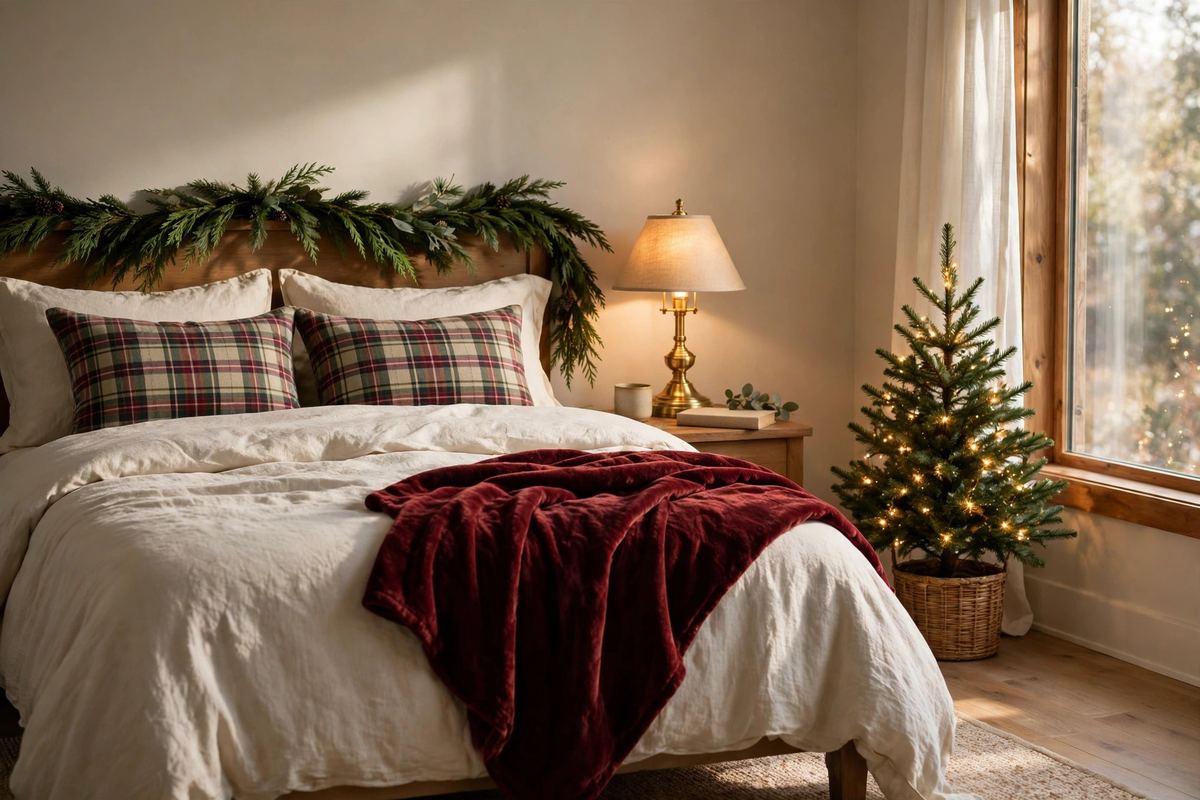
1. The four-layer bed — $60 to $110. Start with the bed, because it is the largest surface in the room and the bedding does more decorating than every ornament combined. Layer four textures: crisp cream sheets, a duvet in cream or soft plaid, a chunky knit throw folded across the foot, and one velvet cushion in burgundy. The layers do the decorating for you — the bed looks dressed and generous — and at night you peel back exactly as much warmth as you want. A chunky knit throw costs $25 to $45, a velvet cushion cover $12 to $20, and both earn their keep all winter.
2. The plaid duvet swap — $30 to $60. If you want one change that reads as Christmas from the doorway, swap the duvet cover for a plaid one in forest green and burgundy, and keep everything else the same. One plaid layer is a statement; plaid bedding plus plaid cushions plus a plaid throw is a pattern fight. A cotton flannel plaid duvet set costs $30 to $60, it washes easily, and in January it swaps straight back out — which is the test for every seasonal bedding purchase.
3. The three-cushion rule — $25 to $45. Three cushions on the bed, not six: two sleeping pillows in cream cases, one burgundy velvet cushion and one small plaid accent in front. Odd numbers look styled, and three cushions take ten seconds to clear at bedtime, while six take a minute and end up on the floor every night. Keep the cushion covers washable — December cushions collect candle soot, cocoa, and pine needles faster than any other month.
4. The throw over the foot, not the pillow — $0 extra. Fold the throw across the foot of the bed, not draped over the pillows. A throw at the foot looks intentional and stays put; a throw over the pillows slides off the first time you sit down, and it hides the pillows you actually sleep on. This costs nothing and it is the difference between a bed that photographs well and a bed that lives well.
5. The winter bedding that stays past Christmas — $0 to $40. Choose bedding layers that are winter decor, not Christmas decor: cream linen, chunky knit, plain burgundy velvet. When the tree comes down in January, the knit throw and the velvet cushion stay, and the room steps back to itself without feeling bare. If a piece only works with a tree beside it, it is Christmas decoration; if it works in February too, it is a good buy.
Warm Light: Ideas 6 to 8
6. The headboard fairy lights — $12 to $25. Weave one string of warm-white fairy lights along the headboard, tucked behind the top rail so the bulbs glow without glaring. One 33-foot string with 100 lights suits a queen headboard; keep every bulb at 2700K, because one cool-white string among warm lights makes the whole room feel like an office. Put the lights on a timer that switches off an hour before bedtime — Christmas light is for evenings, not for sleep.
7. The bedside lamp swap — $8 to $15. Swap the bedside bulbs for warm 2700K bulbs and add a dimmer, or a lamp with a low setting, so the room has a reading light that does not fight the fairy lights. Two lamps at the same warm temperature, one on each side of the bed, make the room glow evenly; a bright overhead light flattens every decoration in the room, however good it is. This is the cheapest idea in the guide and the one guests notice least and you feel most.
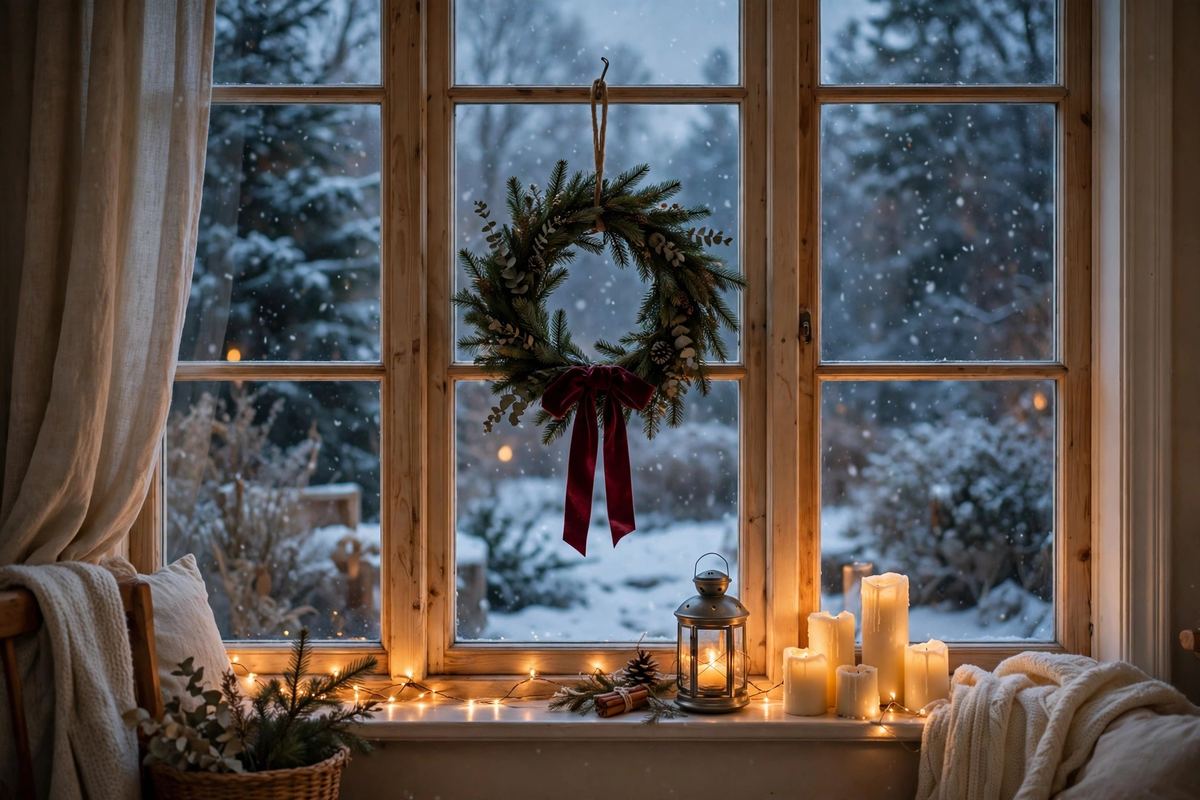
8. The flameless candle nightstand — $15 to $30. Three flameless pillar candles in different heights — 4, 6, and 8 inches — on one nightstand, with a sprig of pine laid in front of them, instead of a candle on each side. A cluster reads as a display; a candle on each side reads as an afterthought. A set of three flameless candles with a timer costs $12 to $20, switches itself on at dusk, and sits safely beside bedding and evergreen, where real candles never should. Our Christmas window decor ideas use the same flameless rule on the sill, for the same reason.

The Bedroom Tree: Ideas 9 to 11
9. The slim corner tree — $40 to $80. A slim 4-foot tree in a woven basket, in the corner by the window, is the bedroom tree that works in most rooms. The corner gives the tree a backdrop on two sides, the window light plays off the ornaments in the daytime, and the tree lights glow against the glass at night. A 4-foot tree suits an 8-foot ceiling with room to spare, and a basket base hides the stand from every angle. Keep 18 inches of clear walkway around the tree, or every trip to the wardrobe becomes an ornament rescue.
10. The tabletop tree on the dresser — $25 to $50. In a small bedroom, skip the floor tree and put a 2- to 3-foot tabletop tree on the dresser instead. Dress it simply — a few matte ornaments, one ribbon, a small basket at the base to hide the stand — and let it carry the room's festive message so nothing else has to shout. A tabletop tree under 3 feet keeps the dresser usable, the floor clear, and the proportions honest, which is why it beats a tall tree squeezed into a small room every time.
11. The quiet tree — $0 to $20. Decorate the bedroom tree more quietly than the living-room tree: warm-white lights, one ribbon, and ornaments in two materials — matte glass and wood — instead of the full mixed box. A quiet tree suits a room meant for sleep, and it costs less, because the ornaments can come from the same box as the big tree. Our DIY Christmas ornament ideas make the dried oranges and simple wooden ornaments in one afternoon, enough for both trees.
Headboard, Window and Nightstand: Ideas 12 to 15
12. The headboard garland — $25 to $45. A slim cedar garland along the top of the headboard, kept thin — no thicker than 4 inches — so it frames the bed instead of hanging over the pillows. Fresh cedar costs $20 to $35 for a 6-foot length; good faux cedar costs $25 to $45 and stores for next year. Our Christmas garland ideas cover fresh versus faux and how to hang a garland without nails, which matters above a bed: use adhesive hooks rated for the weight, never tape, and keep the garland off the pillows so nothing drops on you in the night.
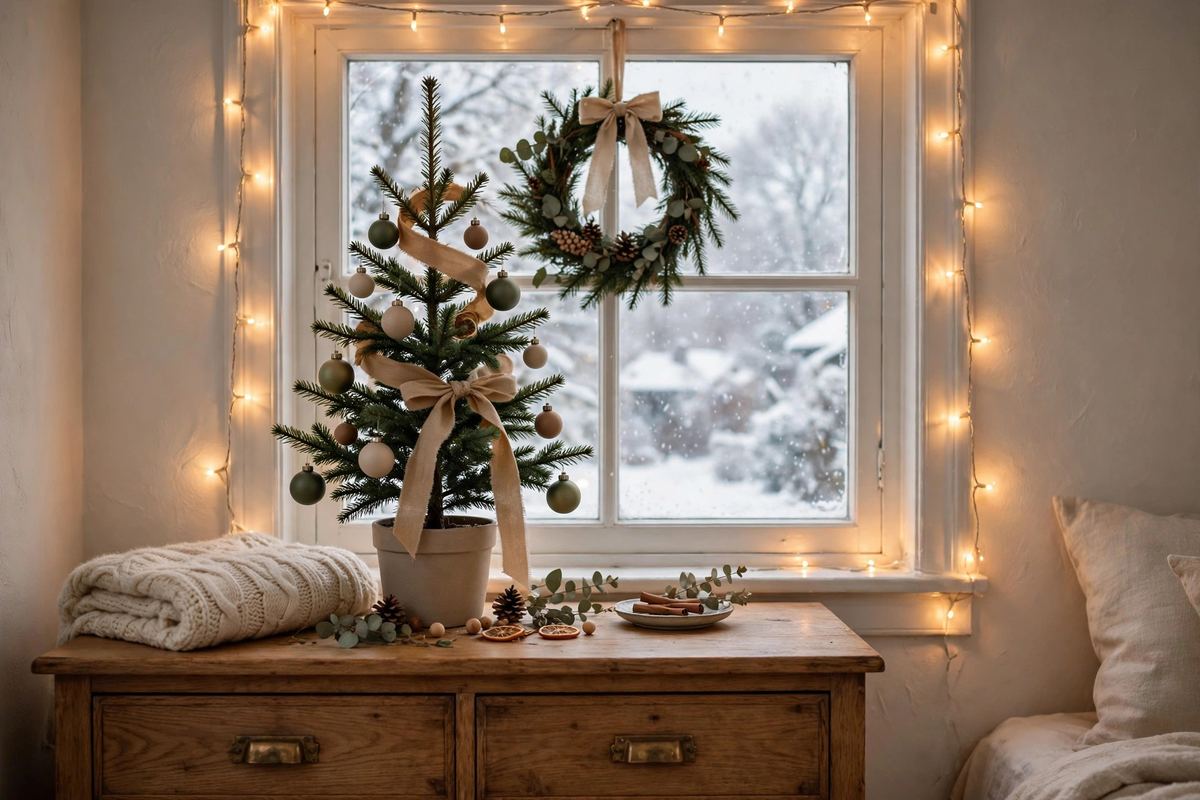
13. The window wreath and fairy-light frame — $25 to $40. A small wreath in the bedroom window, on a burgundy ribbon, with fairy lights along the frame — the same wreath, ribbon, and lights as the rest of the room, seen from the bed as a glowing frame and from the street as the house decorated. Our Christmas wreath ideas cover the sizing and hanging methods that hold on glass, and the rule that matters here: keep the middle of the glass clear, so the daylight survives and the window frames the room instead of blocking it.
14. The three-object nightstand — $0 to $20. Keep each nightstand to three objects: one lamp, one candle or small vase with a pine sprig, and one book or water glass. A nightstand is a working surface — phone charger, water glass, book — and a fourth decoration is the one that gets knocked over in the dark. The three-object rule is free, and it is the idea that keeps a decorated bedroom livable through the whole of December.
15. The scent layer, kept gentle — $10 to $20. One gentle scent for the bedroom: a pine or cedar reed diffuser on the dresser, or a small bowl of pinecones with a drop of cedar oil. A soft, consistent scent is what you remember about the room the next morning, and it ties the bedroom to the rest of the decorated house. Keep scent to one source — a diffuser and a candle and a simmer pot together smell like a candle shop, not a home — and never burn a real candle in a bedroom while you sleep.
Layouts That Work in Real Bedrooms
In a small bedroom, the plan shrinks, not the palette: a tabletop tree on the dresser, fairy lights on the headboard, three cushions on the bed, and nothing on the floor except the laundry basket. Skip the floor tree, skip the village on the sill, and keep the nightstands to three objects each — a small room decorated lightly feels cozy, and the same room decorated heavily feels cluttered. The test is the walkway: if you can cross from the door to the bed without turning sideways, the layout works.
In a guest bedroom, the same plan works with one extra rule: keep surfaces mostly clear. Guests need empty space for a suitcase, a phone charger, and a water glass more than they need another vignette, so dress the bed, light the window, and leave the dresser top half empty. In a room with no headboard, the garland moves to the window frame or the dresser mirror, and the fairy lights move to the mirror frame — the rules do not change, only the furniture that carries them does.
The One-Weekend Plan and Real Costs
Saturday morning, buy or gather your pieces: bedding layers, fairy lights, a small tree or tabletop tree, garland, and flameless candles. Saturday afternoon, do the room in order: bed first, because it is the biggest surface and sets the palette; lights second, headboard and window; tree third, in its corner or on the dresser; then the nightstands and the scent layer. Saturday at dusk, switch the overhead light off, check the room from the bed, and adjust anything that blocks a walkway or crowds a nightstand. Sunday, put the lights on timers, set the candles to switch on at dusk, and the room runs itself for the rest of the season.
On cost, a full bedroom plan — bedding layers, lights, a small tree, garland and nightstand styling — runs about $150 to $280 if you buy everything new: bedding $60 to $110, lights $20 to $40, tree $40 to $80, garland $25 to $45, candles and scent $25 to $50. A bedding-and-light refresh alone — one throw, two cushion covers, a string of fairy lights and flameless candles — costs $60 to $110, which is why the bedroom is the best value in Christmas decorating after the living room: it is the room you wake up in, and every dollar spent there is seen first thing on Christmas morning.
When the season ends, take the tree down in the first week of January, before the needles fade, and store the ribbon rolled, not folded, so it does not crease for next year. Leave the knit throw and the plain velvet cushion out all winter — they are winter decor, not Christmas decor — and the room steps back to itself without feeling bare, which is the sign the plan worked: Christmas added to the room, it never replaced it.
Mistakes to Avoid
- Decorating the bed so you cannot sleep in it. Six cushions, a throw over the pillows, and lights that stay on all night make a display, not a bed. Three cushions, a throw at the foot, lights on a timer.
- Putting a big tree in a small bedroom. A 6-foot tree in a bedroom eats the floor and the walkway. A slim 4-foot tree in a corner, or a tabletop tree on the dresser.
- Mixing light colors. One cool-white string among warm-white lights ruins the evening. Check every box for 2700K before you buy.
- Putting real candles beside bedding or evergreen. Flameless candles give the same glow on a nightstand without the risk, and they run on a timer.
- Blocking the window. A wreath that covers the glass blocks the daylight. Keep the middle of the glass clear; frame the window, do not fill it.
- Crowding the nightstand. A nightstand with five decorations is a nightstand you cannot use. Three objects: lamp, candle or vase, book or water glass.
- Leaving the overhead light on. One ceiling light flattens every decoration. Low, warm layers — headboard lights, lamps, candles — make the room.