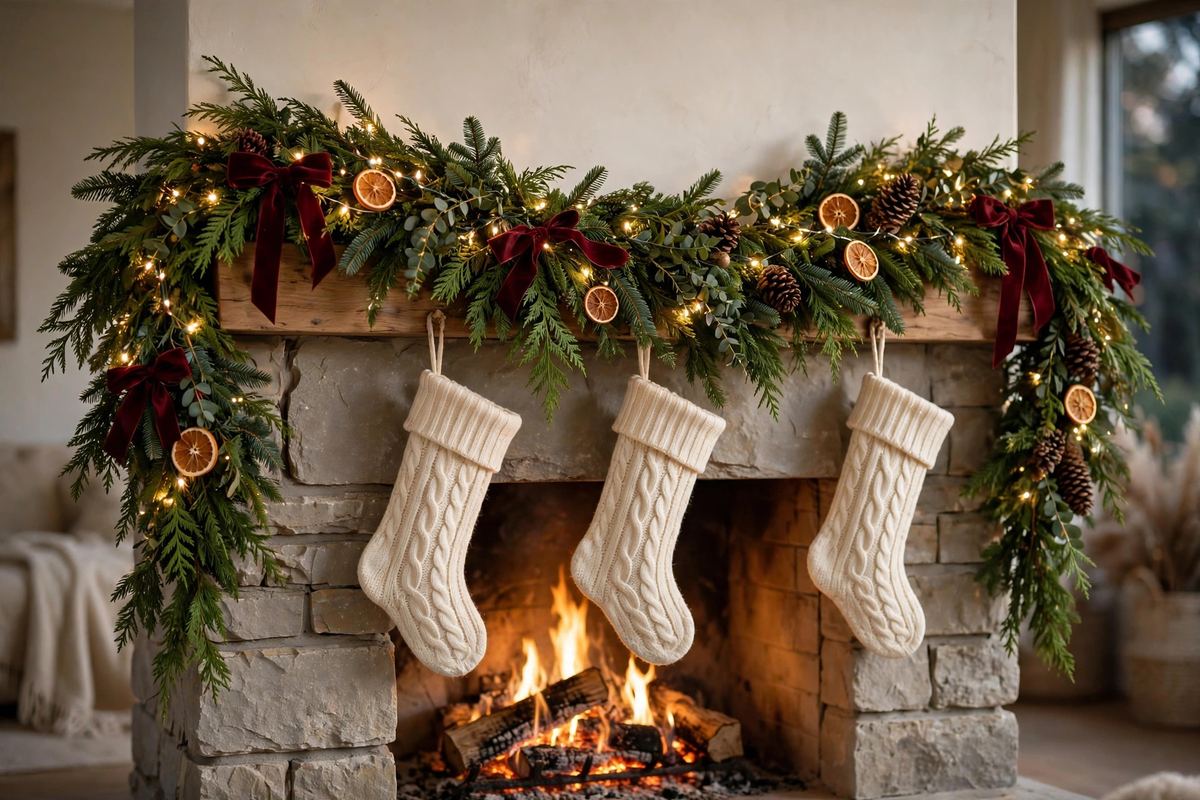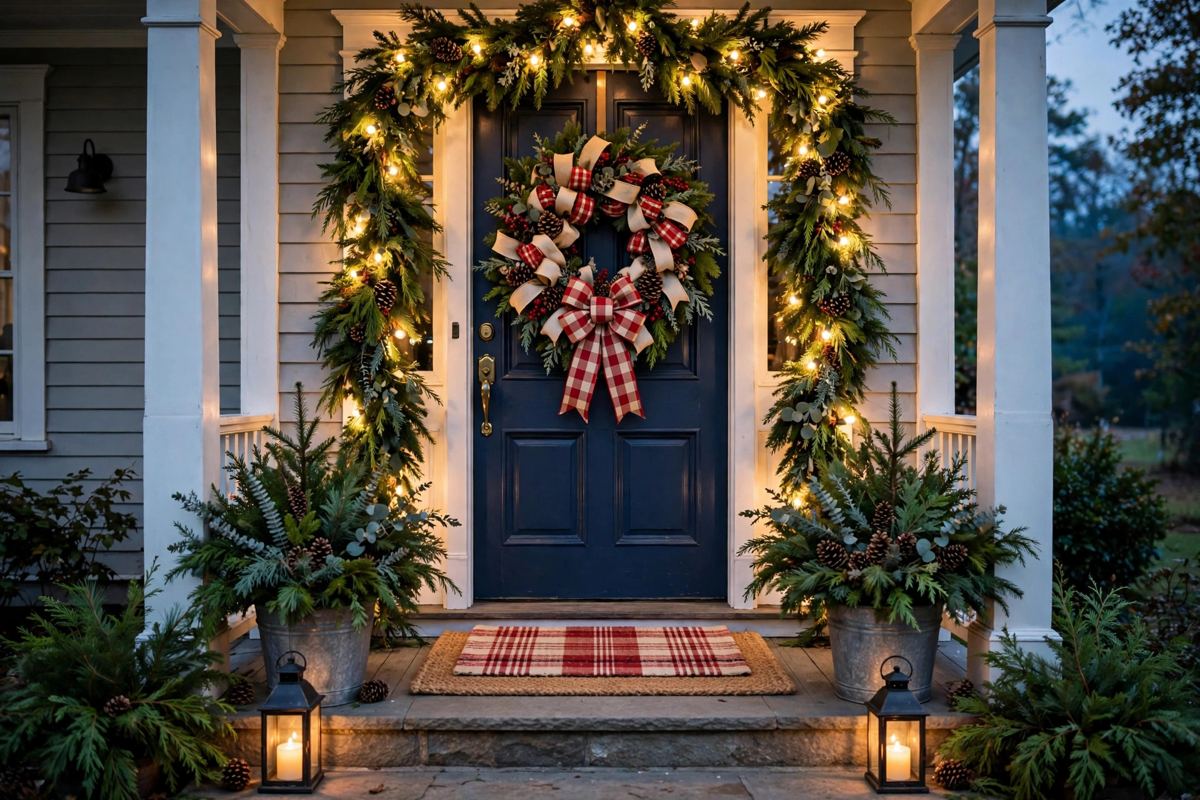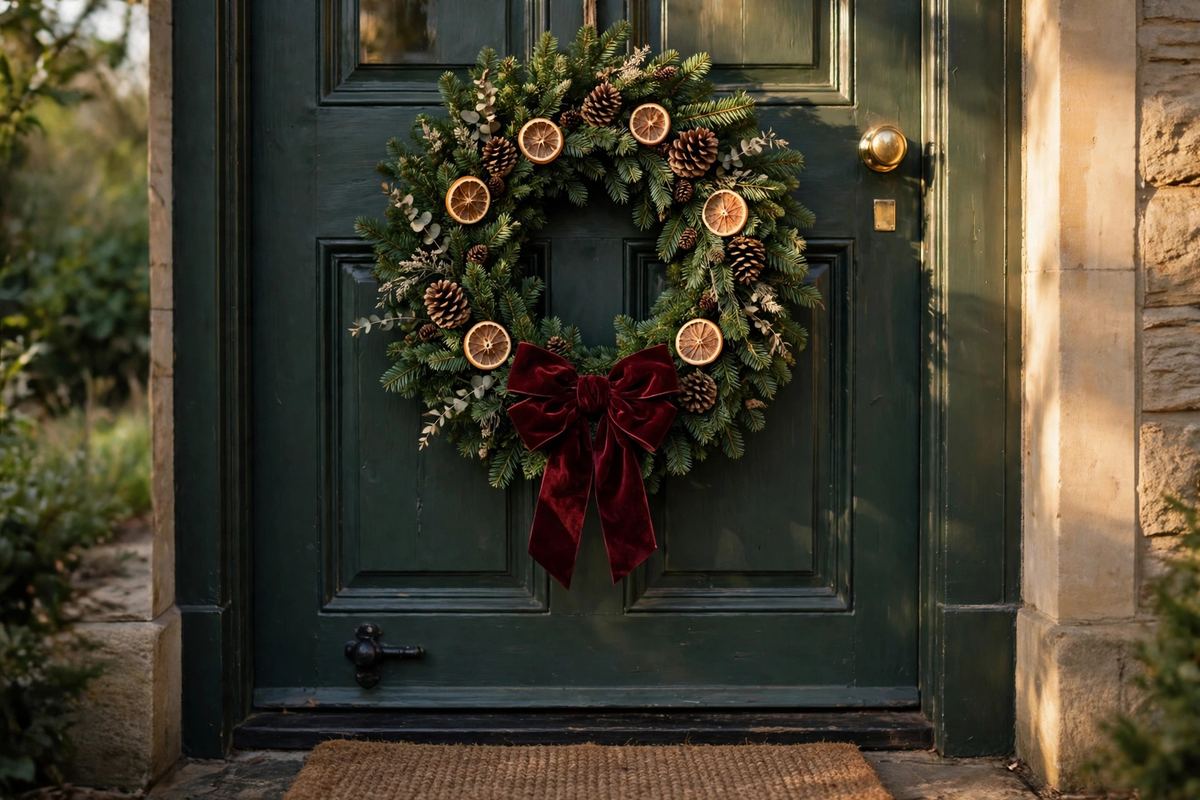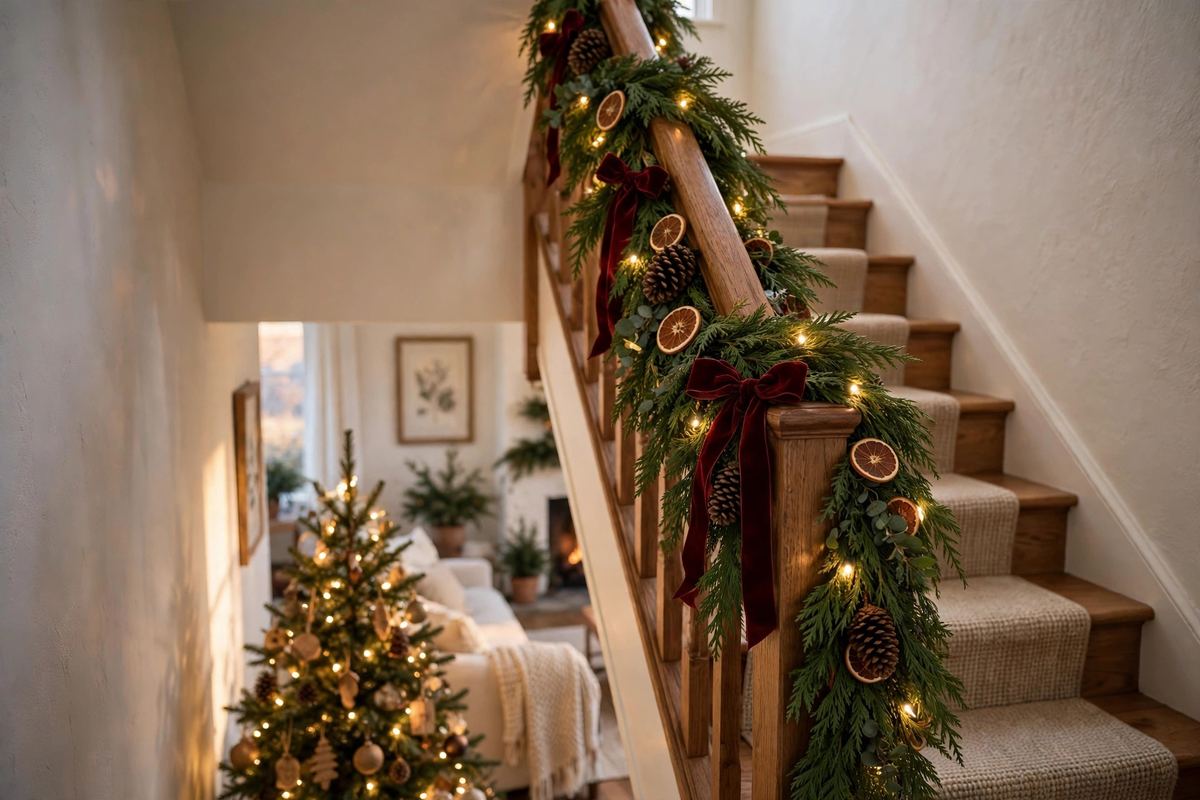
Here is the truth about christmas staircase decor: most staircases get decorated last, with whatever garland is left after the mantel and the tree — and it shows. A staircase is the first thing guests see when they walk in, and it is the one decoration in the house that runs the full height of a room, so a thin, half-hearted garland reads instantly, while a full one makes the whole house feel decorated. The good news is that a staircase takes less than an afternoon and less than $100 to do properly, because the banister does most of the work for you.
This guide gives you 15 Christmas staircase decor ideas, in five groups: the garland base, no-nails hanging, ribbon and lights, the newel post and landing, and ideas for every staircase type. Every idea carries a real cost, a real measurement, and the mistake to avoid. It ties the whole Christmas cluster together — the garland from our Christmas garland ideas, the velvet bows from our velvet bow Christmas decor, and the entryway story from our front porch Christmas decor ideas, so the outside, the staircase, and the rooms all speak the same language.
Start With the 4 Staircase Rules
Rule one: measure first, buy second. Measure the handrail from the newel post to the top of the stairs, then add 10 percent for a straight run or 25 percent for swags — a garland that comes up short in the middle of the run is the one mistake you cannot hide, and it is the mistake almost everyone makes. Rule two: keep the handrail grippable. The staircase is still a staircase in December, so the garland runs below the rail or along the balusters, never wrapped over the top where hands need to hold, and nothing dangles at head height on a narrow flight.
Rule three: one palette, the whole staircase. Pick three colors — ours is warm evergreen, burgundy, and cream — and repeat them on the garland, the bows, and the newel post, so the staircase reads as one display instead of a collection of leftovers. Rule four: light it warm, 2700K on every string, because the staircase is seen mostly in the evening, and one cool-white string among warm lights makes the whole run look cold. These four rules carry every idea below, and they are why a $60 staircase can look better than a $200 one that ignored them.
The Garland Base: Ideas 1 to 4
1. The full faux base — $30 to $60. Start with one generous faux garland, thick enough to hide the handrail's fixings and hold its shape all season, and lay it along the banister before adding anything else. A full base does the heavy lifting: it covers gaps, hides the ties, and makes the staircase read lush from across the room even before the ribbon and lights go on. A 9-foot faux cedar garland costs $30 to $60, and because faux greenery never wilts, the base stays handsome from the first weekend of December right through to New Year. Our Christmas garland ideas compare fresh versus faux in detail — for a staircase, faux wins, because fresh garland sheds needles onto the steps, and needles on stairs are a slipping hazard.
2. The layered double garland — $55 to $110. For a wide staircase, layer two garlands: a full pine base for volume, then a slimmer cedar or eucalyptus garland woven through it for texture. Two different greens read richer than one, and the slimmer second garland fills the gaps the first one leaves, so the run looks thick from both the bottom and the top of the stairs. Buy both in the same length and join them end to end with floral wire, not tape, so the join sits inside the greenery where no one can see it. On a narrow staircase, skip this idea — one full garland is already enough, and two will crowd the rail.
3. The fresh-cedar accent — $20 to $40. If you love the smell of real greenery, add fresh cedar as an accent, not the base: tuck short fresh sprigs into a faux base garland, so you get the scent and the softness of real cedar without the shedding and the weight of a full fresh run. Fresh cedar sprigs cost $15 to $25 a bunch from a florist or garden center, and they last two to three weeks indoors if you mist them every few days. Replace the sprigs once, mid-December, and the staircase smells fresh for the whole season — the only maintenance a staircase garland ever needs.
4. The flocked garland for a light room — $40 to $70. In a bright room with white walls and pale wood, a flocked garland — faux greenery dusted with artificial snow — reads softer and more finished than plain green, and it needs almost no ornaments, because the flocking is the decoration. Keep the flocked look clean: white lights, cream ribbon, and no colored ornaments, or the snow effect disappears under the color. Flocked garlands shed a little when handled, so hang them once, shake them outside first, and avoid running a vacuum brush over them mid-season.
Hang It Without a Single Hole: Ideas 5 to 7
5. Fabric ties every 18 inches — $5 to $12. The best no-nails method is also the cheapest: fabric-covered ties, or strips of ribbon, looped around a baluster and the garland every 18 to 24 inches, with the knot tucked inside the greenery. A six-pack of fabric ties costs about $5, and the ties do double duty — they hold the garland and they look like part of the decoration, especially in cream or burgundy to match the palette. Support the garland along its full length instead of relying on the ends, because a garland held only at the top and bottom sags in the middle within a week, and a sagging garland is the fastest way to make a staircase look tired.
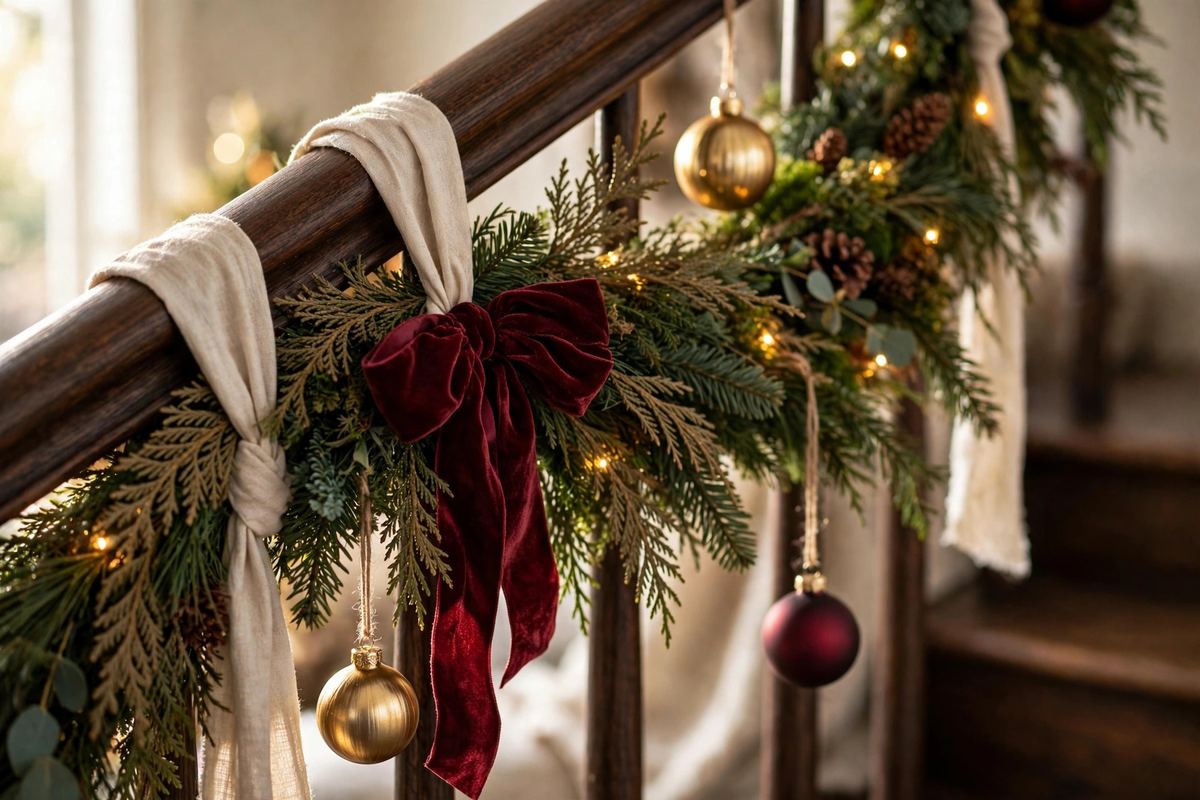
6. The shallow swag — $0 extra. Instead of running the garland straight along the rail, let it dip gently between attachment points, so it hangs in shallow swags down the staircase. Swags make a plain garland look custom, because the eye follows the wave instead of a straight line, and they cost nothing — the same garland, hung with a little slack between ties, is all it takes. Keep the dips shallow, 6 to 8 inches below the rail, so the swag never hangs into the walkway or blocks the handrail grip. Deep swags belong on a mantel, not a staircase, where someone has to walk past them carrying things.
7. The landing-turn overlap — $0 extra. If your staircase changes direction at a landing, make the turn the richest point: overlap two garland ends there, add an extra bow, and let the greenery run a little fuller for one step in each direction. The turn is where the eye naturally pauses on a staircase, so a little extra fullness there reads as deliberate rather than accidental, and it hides the join between two garland lengths at the same time. This is the detail that separates a staircase that looks decorated from one that looks designed, and it costs nothing but a spare bow and five minutes.
Ribbon, Lights and Ornaments: Ideas 8 to 11
8. The velvet ribbon run — $15 to $30. Weave a wide burgundy velvet ribbon through the garland in long, loose loops, or tie a bow at every third baluster — not both, or the staircase gets busy. Three rolls of 2.5-inch velvet ribbon, $5 to $10 each, cover a standard flight, and the same ribbon then ties the wreath on the door and the bows on the tree, which is how a house starts to look coordinated instead of decorated room by room. Our velvet bow Christmas decor covers the bow-tying method that keeps loops even, and the rule that matters on a staircase: tie the ribbon to the garland, not to the rail, so the handrail stays clear for hands.
9. Lights woven in before hanging — $15 to $35. Weave the lights through the garland on the floor, before the garland goes up — not after, when half the string ends up on the outside and half buried where no one sees it. About 100 warm-white lights per 6 feet of garland gives a full glow without hot spots, and a battery string with a timer is the easy choice when no outlet sits near the stairs, because it switches itself on at dusk and off after six hours. Check every box for 2700K before you buy, and never mix a cool-white string into a warm run: one cool string makes the whole staircase look cold, and you will notice it every evening.
10. Ornaments at three heights — $10 to $25. Hang shatterproof ornaments from the garland at three heights — one tucked deep in the greenery, one at the edge, one dangling just below — using clear fishing line or short ribbon loops, three to five ornaments per swag and no more. Mixed sizes read better than matched ones: a large gold ball, a medium burgundy bauble, and a small pinecone in each cluster, all in the palette, repeated down the run. Use shatterproof ornaments only on a staircase, because a glass bauble knocked off a banister lands on a hard step, and a broken ornament on stairs is a barefoot hazard for the rest of the evening.
11. The dried-orange and pinecone finish — $8 to $15. Tuck dried orange slices and pinecones into the garland last, after the ribbon and lights, because they are the finishing layer that sits on top of everything else. Dried oranges cost almost nothing to make — slice, low oven, one afternoon — and our DIY Christmas ornament ideas give the exact method, enough for the staircase, the mantel, and the tree in one batch. Wire the pinecones in with floral wire, do not glue them, so they survive the season and come off cleanly in January, and keep both away from the handrail grip: decoration belongs in the greenery, not where hands go.
Newel Post, Landing and Steps: Ideas 12 to 13
12. The newel-post statement — $10 to $20. The newel post is the exclamation mark at the bottom of the staircase, so give it the biggest bow in the house: one oversized burgundy velvet bow, loops at least 8 inches across, tied where the garland meets the post, with tails long enough to fall 12 to 18 inches. A big bow at the newel post anchors the whole run, and it is the detail guests photograph, because it sits at eye height where the staircase begins. Keep the largest bow at the bottom newel post and let smaller bows repeat up the run every 4 to 5 feet, so the staircase reads as a rhythm, not a single decoration at the bottom.
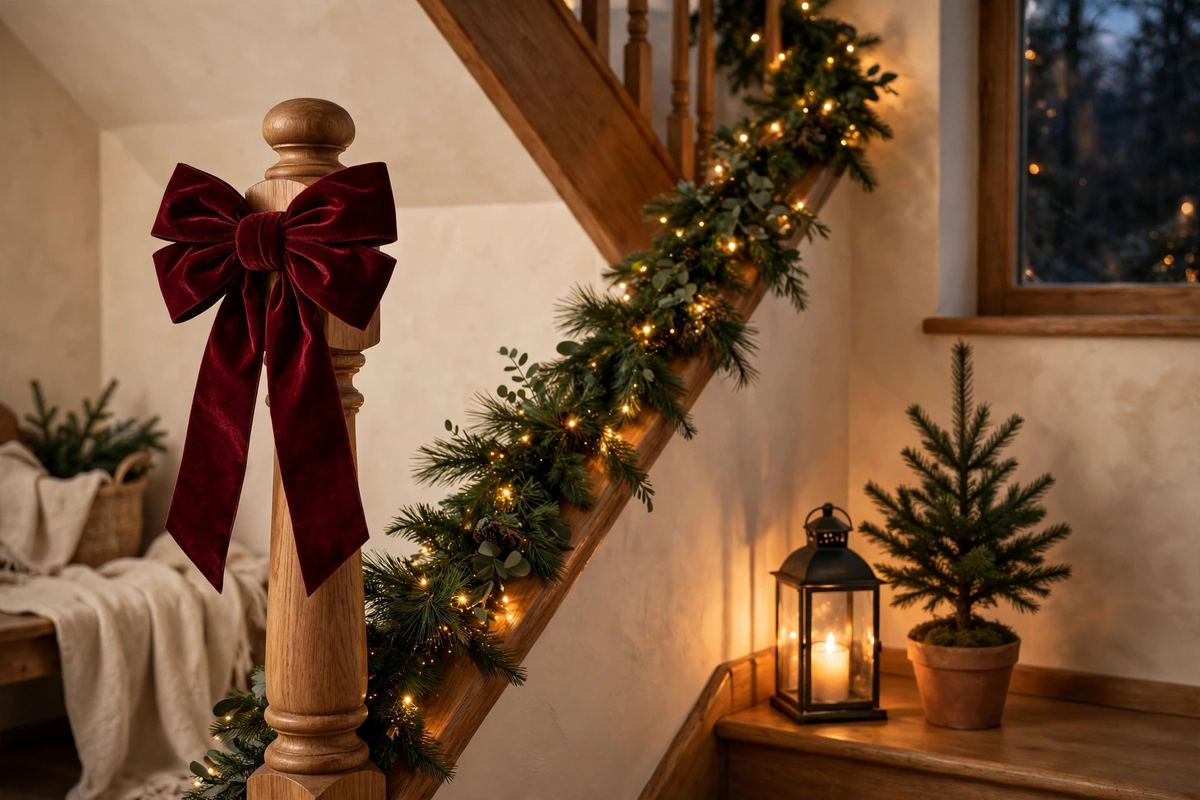
13. The landing vignette — $20 to $45. If the staircase has a landing or a wide bottom step, finish it with a small vignette that never blocks the walkway: a glowing lantern with a flameless candle, a small potted pine in a terracotta pot, and nothing else. The landing vignette is the staircase's version of a mantel display, and it works because it sits where the staircase pauses, not where people walk — keep it against the wall side, never on the step edge, and never tall enough to block the rail. A lantern with a timer candle costs $15 to $30, a potted pine $8 to $15, and together they make the bottom of the stairs glow in the evening, which is when the staircase is seen most.
Every Staircase Type: Ideas 14 to 15
14. The narrow staircase — $40 to $70. On a narrow flight, the whole look shrinks: one slim garland on the wall side, lights woven in, one bow at the newel post, and no hanging ornaments at all, because anything dangling at shoulder height on a narrow flight gets knocked off within a week. Keep the open side completely clear, so the staircase stays safe to use with both hands free, and let the garland do the work — a slim, full garland reads generous even in a tight space, while a thick garland in a narrow stair reads as clutter. The test is simple: if two people can pass on the stairs without touching a decoration, the narrow staircase is done.
15. The modern staircase — $35 to $65. A modern staircase — cable railing, glass panels, or floating steps — needs a lighter touch than a traditional banister, because the architecture is the decoration. Use a thin eucalyptus garland, light enough to drape without sagging, with slim ornaments and fairy lights woven through the cables or laid along the wall-side stringer, never wrapped around glass panels where suction or tape would mark the surface. Skip the big velvet bows here and use slim cream ribbon instead, so the staircase keeps its clean lines, and keep every attachment to the railing structure itself — clamps and ties on metal, never adhesive on glass, which leaves residue that shows in daylight all year.
Safety Rules That Matter
A decorated staircase is still a staircase, so the safety rules are not optional extras. Keep the handrail grippable along its full length: garland below the rail or along the balusters, never over the top. Keep every step clear — no lanterns, gift boxes, or mini trees on the steps themselves, only on landings and against walls, because anything on a step is a trip hazard in the dark. Use flameless candles only near greenery, and keep real candles off the staircase entirely, because a staircase is the one place in the house where a knocked candle has nowhere safe to fall.
Use shatterproof ornaments, battery lights with timers so no extension cord crosses a step, and ties rated for the garland's weight — a heavy garland held by one weak tie at each end will come down, usually at night, usually onto the stairs. Check the ties once a week, after the first week and after any house with children or pets has been through, and tighten anything that has slipped. A staircase that is safe to use in the dark, in socks, carrying a mug, is a staircase that is decorated properly — everything else is just how it looks in a photo.
The One-Weekend Plan and Real Costs
Saturday morning, buy or gather your pieces: garland, lights, ribbon, fabric ties, ornaments, and one big bow for the newel post. Saturday afternoon, work in order: weave the lights through the garland on the floor first, then hang the garland with fabric ties every 18 inches, then add the ribbon, then the ornaments and pinecones, then the newel-post bow and the landing vignette last. Saturday at dusk, switch the overhead light off, check the staircase from the bottom and the top, and adjust anything that blocks a handrail grip or dangles into the walkway. Sunday, put the lights on timers, check the ties once, and the staircase runs itself for the rest of the season.
On cost, a full staircase plan — one full garland, lights, ribbon, ties, ornaments, and a newel-post bow — runs about $85 to $160 if you buy everything new: garland $30 to $60, lights $15 to $35, ribbon $15 to $30, ties $5 to $12, ornaments $10 to $25. A garland-and-lights refresh alone — one garland and one light string, reusing last year's ribbon and ornaments — costs $45 to $95, which is why the staircase is one of the best values in Christmas decorating: it is the first thing guests see, it runs the full height of a room, and every dollar spent there is seen every time someone walks in or out. When the season ends, take the garland down in the first week of January, roll the ribbon instead of folding it so it does not crease, and store the ornaments in the same box as the garland, so next December the staircase takes an hour, not an afternoon.
Mistakes to Avoid
- Buying the garland before measuring. A garland that comes up short mid-run cannot be hidden. Measure the rail, add 10 percent for a straight run or 25 percent for swags, then buy.
- Wrapping garland over the handrail. Hands need the rail. Garland below the rail or along the balusters, never over the top.
- Holding the garland only at the ends. A garland held at two points sags in the middle within a week. Ties every 18 to 24 inches, full length.
- Mixing light colors. One cool-white string among warm-white lights ruins the evening. Check every box for 2700K before you buy.
- Using glass ornaments on stairs. A knocked glass bauble lands on a hard step. Shatterproof only on a staircase.
- Putting decoration on the steps. Lanterns and gift boxes belong on landings, never on a step edge. Steps stay clear, always.
- Deep swags on a staircase. Deep swags belong on a mantel. On stairs, keep dips shallow — 6 to 8 inches — so nothing hangs into the walkway.