Does your dining room still have that "Gather" sign from 2018 and a matching furniture set that screams "showroom floor"? You are not alone — and you are about three weekends away from a farmhouse dining room that feels warm, collected, and genuinely yours. These 12 farmhouse dining room ideas skip the tired, themed look and build the room the way the best ones actually come together: one great table, honest materials, and lighting that flatters everyone at it.
The secret nobody tells you is that modern farmhouse is not a checklist of signs, baskets, and distressed finishes. It is a feeling of weight and warmth — solid wood you can feel under your hands, linen that softens with every wash, and a room that looks better when people are actually in it. Here is how to get there, idea by idea, with real measurements, exact paint colors, and the mistakes to avoid.
Start With a Real Farmhouse Table
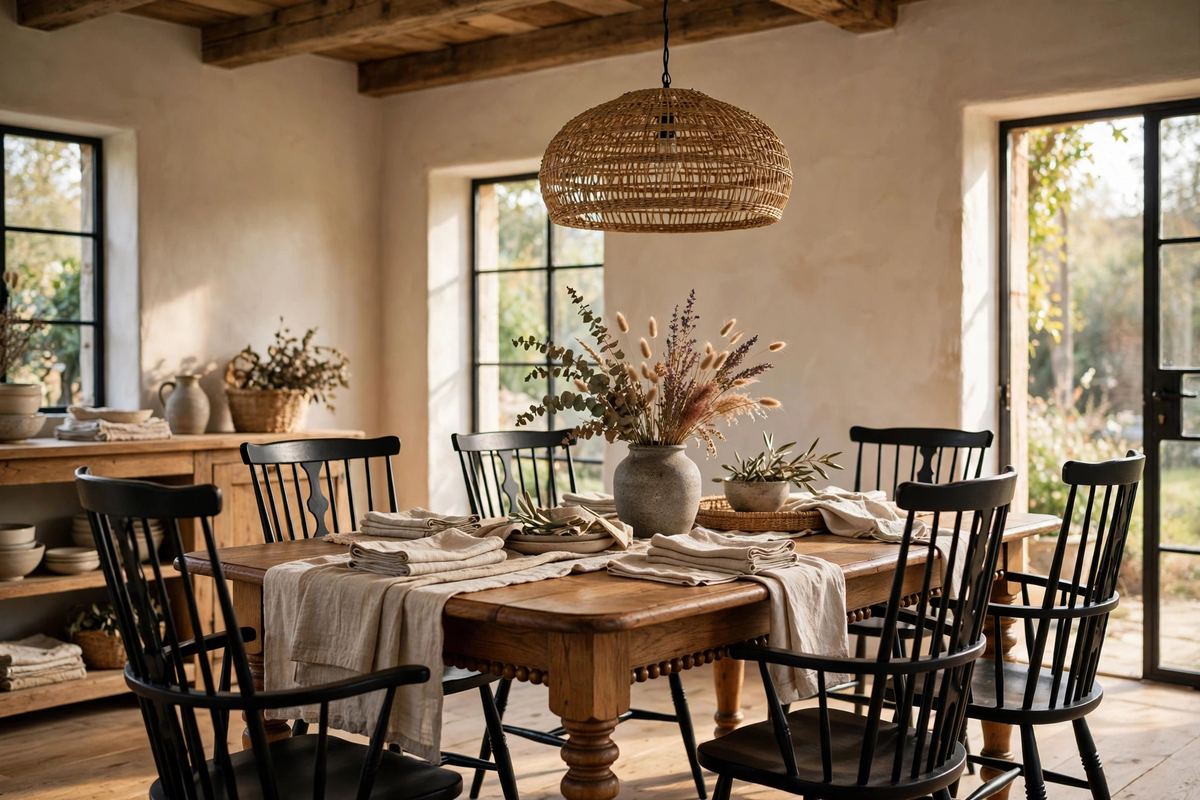
Every great farmhouse dining room starts with one decision: the table. Not a veneer table that chips when someone drops a fork — a solid wood table with turned or trestle legs that gets better with every scratch. This is the piece everything else orbits, so it is worth spending the most here.
Sizing is where people go wrong. A 72 by 40 inch table seats six comfortably (two on each long side, one on each end). For a family of four who hosts holidays, 84 to 96 inches long is the sweet spot. Leave at least 36 inches between the table edge and the wall so chairs pull out without scraping. And if your table wobbles on uneven floors, felt furniture pads under two diagonal legs fix 90 percent of the problem for about six dollars.
Budget reality: a solid wood farmhouse table runs 600 to 1,400 dollars new, but Facebook Marketplace and estate sales regularly turn up beautiful solid-wood vintage tables for 100 to 300 dollars. Look for real joinery, heavy weight, and legs that are actually turned or carved — not molded plastic pretending to be wood.
Mix Your Chairs, Not Match Them
The fastest way to kill the showroom look is to stop buying matching chair sets. A turned-wood farmhouse table looks ten times more expensive with black Windsor chairs on the sides and a simple upholstered bench on one long side — the mix is what makes it feel collected over time instead of delivered in a box.
Keep one rule so the mix feels intentional: repeat one element. All wood tones should live in the same family (warm oak with walnut is fine; warm oak with cherry is a fight), or all seat heights should match within an inch. A bench on one side plus four Windsor chairs is the classic farmhouse move because it seats six while giving kids a spot to slide into. Slipcovered end chairs in natural linen soften the whole arrangement and — bonus — the covers go straight in the washing machine after spaghetti night.
If you love the gathered-chairs formula but want a cleaner, more modern take, these modern organic dining room ideas pair collected seating with round oak tables and sculptural clay pendants.
Paint Colors That Keep Farmhouse Fresh
Paint is the cheapest transformation in the room, and farmhouse dining rooms live or die by undertones. Stark blue-white paint turns warm wood furniture gray and flat. What you want are warm whites with creamy undertones: Benjamin Moore White Dove (OC-17) or Simply White (OC-117) are the two most forgiving choices and they make wood grain glow.
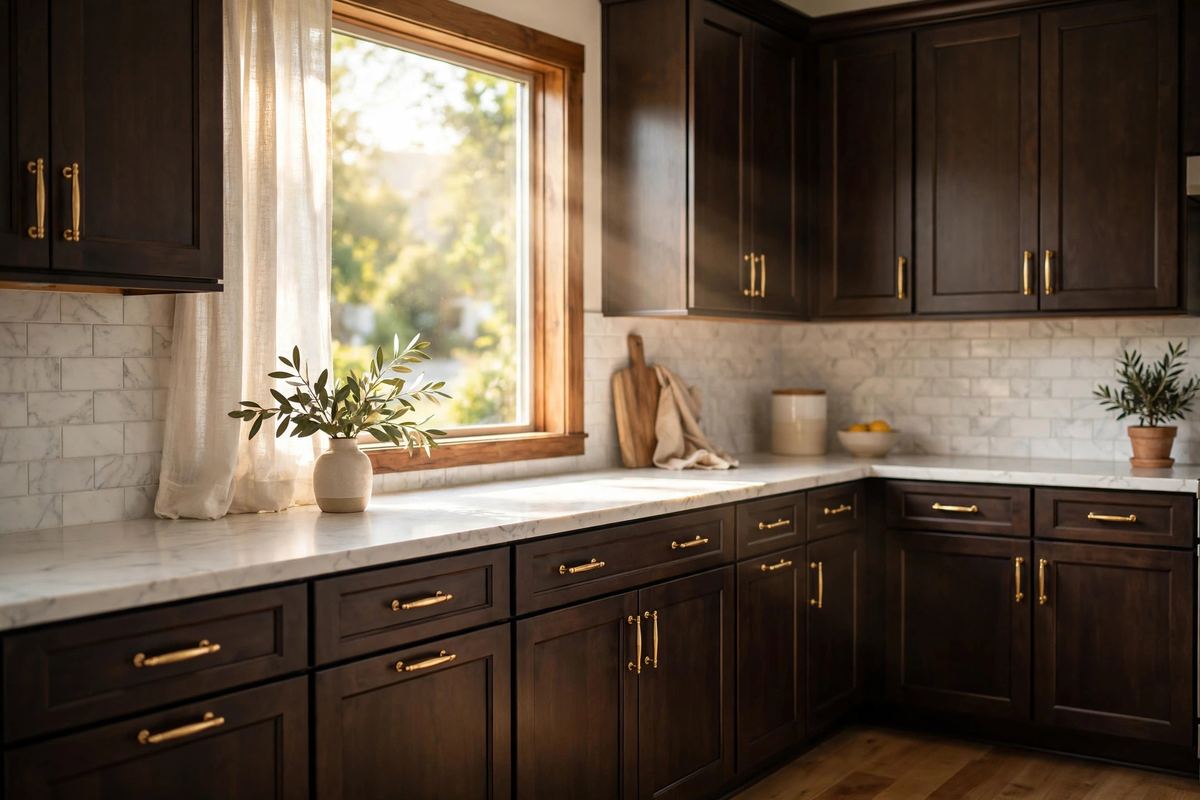
Want more depth? Try a soft greige like Edgecomb Gray (HC-173) on all four walls for a cocooning feel, or paint just one wall a moody green — Sherwin-Williams Pewter Green (SW 6208) or Rosemary (SW 6187) — behind a sideboard for a built-in, collected look. If your kitchen opens into the dining room, carry the warmth through: these warm brown kitchen cabinets pair beautifully with cream dining walls, and a painted kitchen island in a deep tone can anchor the whole open space. A gallon of quality paint covers about 350 square feet, so one gallon usually handles a dining room's walls in two coats.
Get Lighting Right: Measure Twice
Lighting is the single most under-measured element in dining rooms, and it is where most people overspend on the wrong fixture. Two numbers matter. First, hang your pendant or chandelier 30 to 36 inches above the tabletop — lower than you think, high enough that nobody stares into a bare bulb. Second, the fixture should be one-half to two-thirds the width of the table: a 30 to 40 inch wide fixture over a 72 inch table.
For farmhouse dining rooms, three fixture styles never fail: a large woven rattan or seagrass pendant (texture without visual weight), a matte black lantern-style chandelier (structure that reads farmhouse without fuss), or a brass linear fixture over a long table. Whatever you choose, put it on a dimmer — a 15 dollar dimmer switch is the difference between a room that feels harsh at 7 p.m. and one that glows. And always use warm-white bulbs (2700K); daylight bulbs (5000K) will make your cozy farmhouse dining room feel like a dentist's office.
The Five-Minute Tablescape Formula
A farmhouse dining table should look good empty and great dressed — and the formula takes five minutes. Start with a runner, not a full tablecloth: a wool or linen runner in plaid, stripe, or solid natural shows off the wood while adding texture. Add two brass or ceramic taper holders with cream candles, then a low centerpiece of dried eucalyptus, wheat, or whatever is in season. Finish with handmade-looking ceramic plates and folded linen napkins.
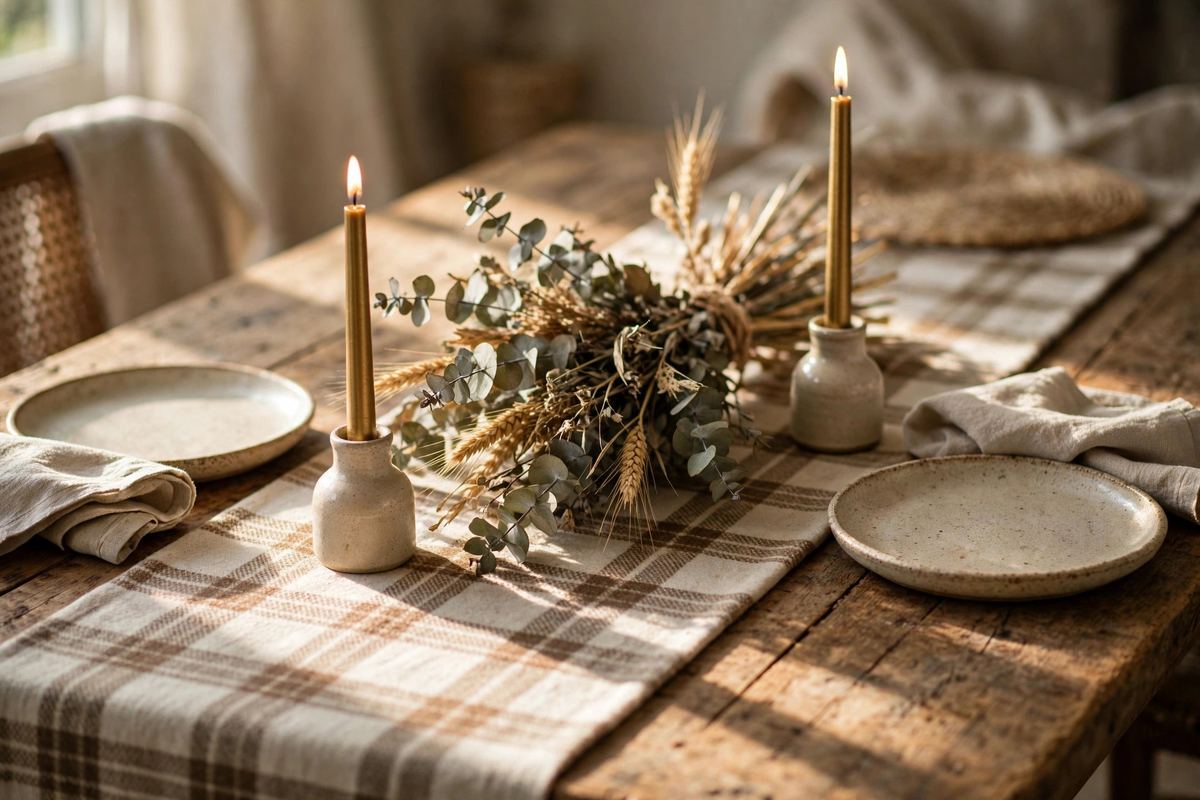
The rule that keeps it from looking staged: vary heights and leave breathing room. Two candle heights, one low centerpiece, and at least a third of the table surface bare. Dried stems are the farmhouse cheat code — a 12 dollar bunch of dried eucalyptus lasts a year, while fresh flowers die by Tuesday. Swap the centerpiece seasonally (wheat in fall, cedar clippings at Christmas, budding branches in spring) and the whole room feels new for almost nothing.
Small-Space Solution: The Banquette Nook
If your dining area is a corner of the kitchen or a small alcove, stop trying to squeeze in a full table set. A built-in or freestanding banquette bench tucked into the corner seats four in the footprint of two chairs — and it instantly makes a small space feel designed rather than cramped.
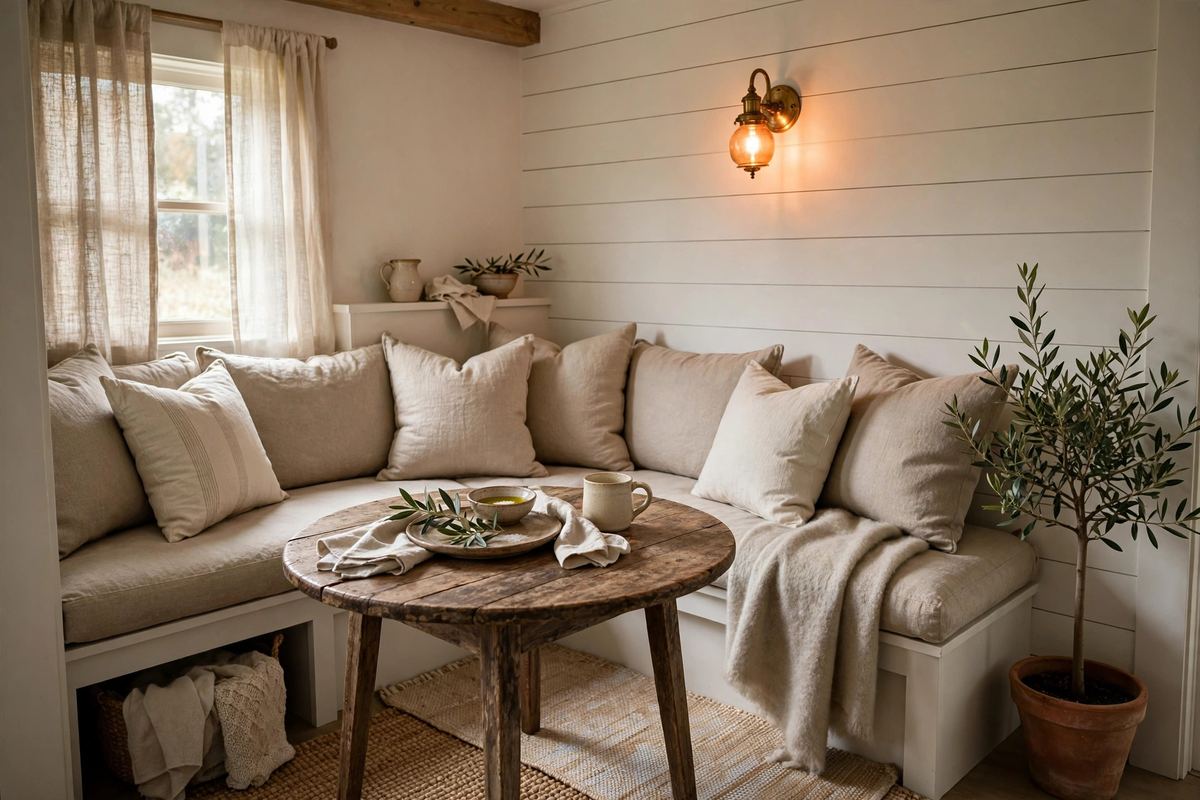
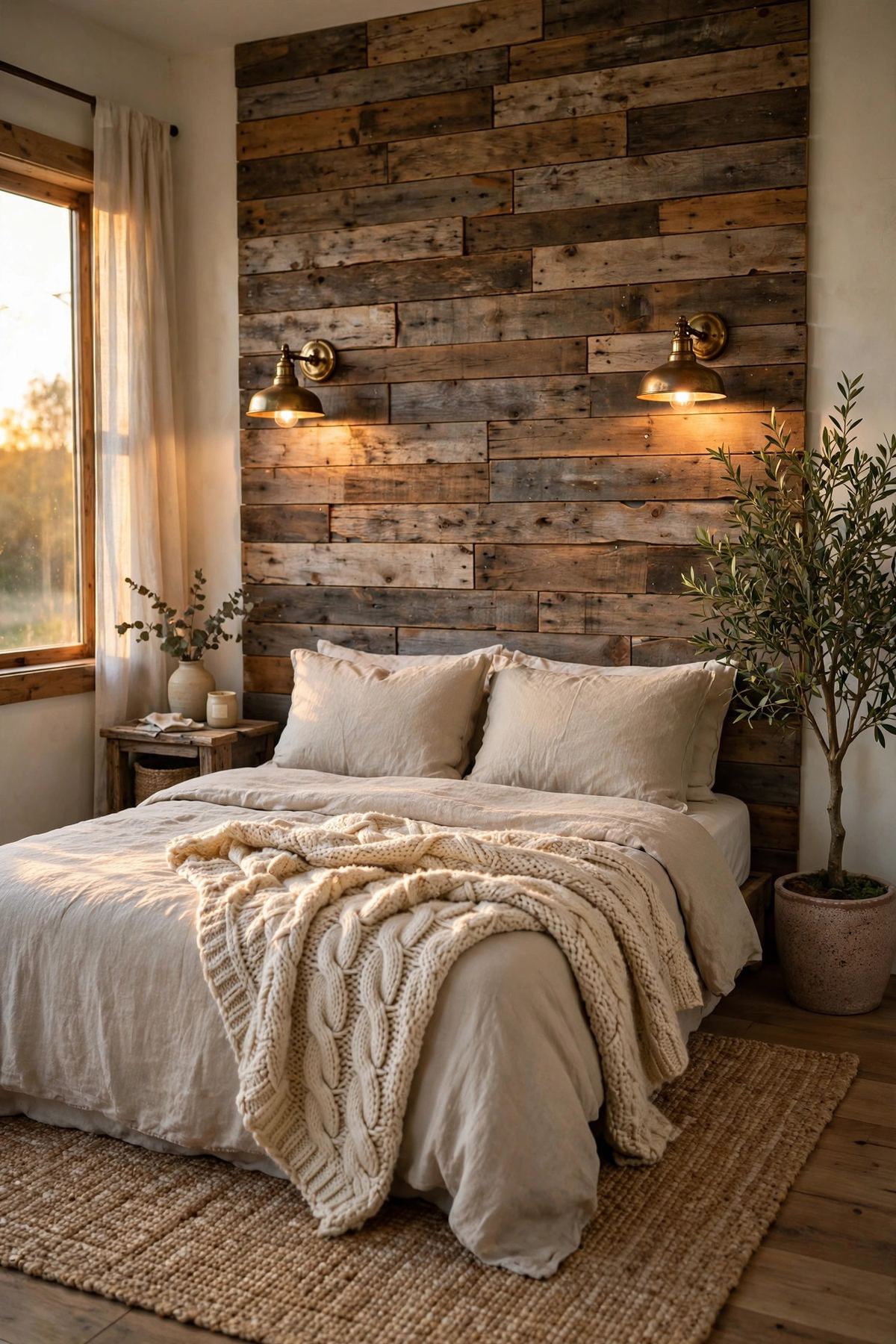
Get the dimensions right and a banquette is the most comfortable seat in the house. Seat height 18 inches (same as a dining chair), seat depth 18 to 20 inches, and a table 28 to 30 inches tall pulled close enough that you are not leaning forward. Add a wall behind it — shiplap, beadboard, or even a reclaimed wood accent wall — and a single warm sconce, and you have a nook that seats the family for breakfast and friends for wine. The bench base doubles as storage for table linens and rarely used serving pieces.
Thrifted Finds That Elevate the Room
Farmhouse style was born from thrifted and handed-down pieces, and the best dining rooms still are. A vintage sideboard or hutch is the highest-impact thrifted piece you can add: it gives you storage, a surface for a lamp and collected ceramics, and instant character no new furniture can fake. Look for dovetail drawers, solid backs, and hardware that feels heavy — signs of furniture built before particleboard.
Other thrifted scores that elevate a farmhouse dining room: ironstone or white stoneware dishes (they stack, they go with everything, and a full set costs 20 to 40 dollars at thrift stores), vintage brass candlesticks (polish optional — unlacquered brass with patina looks better), and linen or cotton tablecloths from estate sales (heavier weave than anything new at the same price). Check our list of budget home makeovers under $100 for more thrift-first room ideas. Inspect wood furniture for wobble and woodworm holes, skip anything that smells of mildew, and always measure your doorway before falling in love with a sideboard.
Skip These Five Dated Farmhouse Traps
The 2026 farmhouse dining room is tailored, not themed. Five things that instantly date the look:
- Word signs. "Gather," "Farmhouse," "Blessed" — the era of text on the wall is over. If you want words, use one vintage enamel sign at most.
- Matching furniture sets. Table, chairs, and hutch from the same collection reads as a showroom. Mix eras and finishes instead.
- Heavy distressing. Lightly worn edges are character; factory-chipped paint in five colors is a costume.
- Mason jars as light fixtures. They had their decade. Brass, black metal, or woven pendants do the same job with more style.
- Gray-washed everything. The gray farmhouse wave is over. Warm whites, natural wood tones, and real color are back.
Pull these out and the room relaxes instantly — what is left is wood, linen, and light, which is all farmhouse ever needed to be.
Follow The Decor Diary on Pinterest
Love the rustic wood look? This DIY reclaimed wood accent wall tutorial walks you through a weekend project that pairs perfectly with a farmhouse dining room.