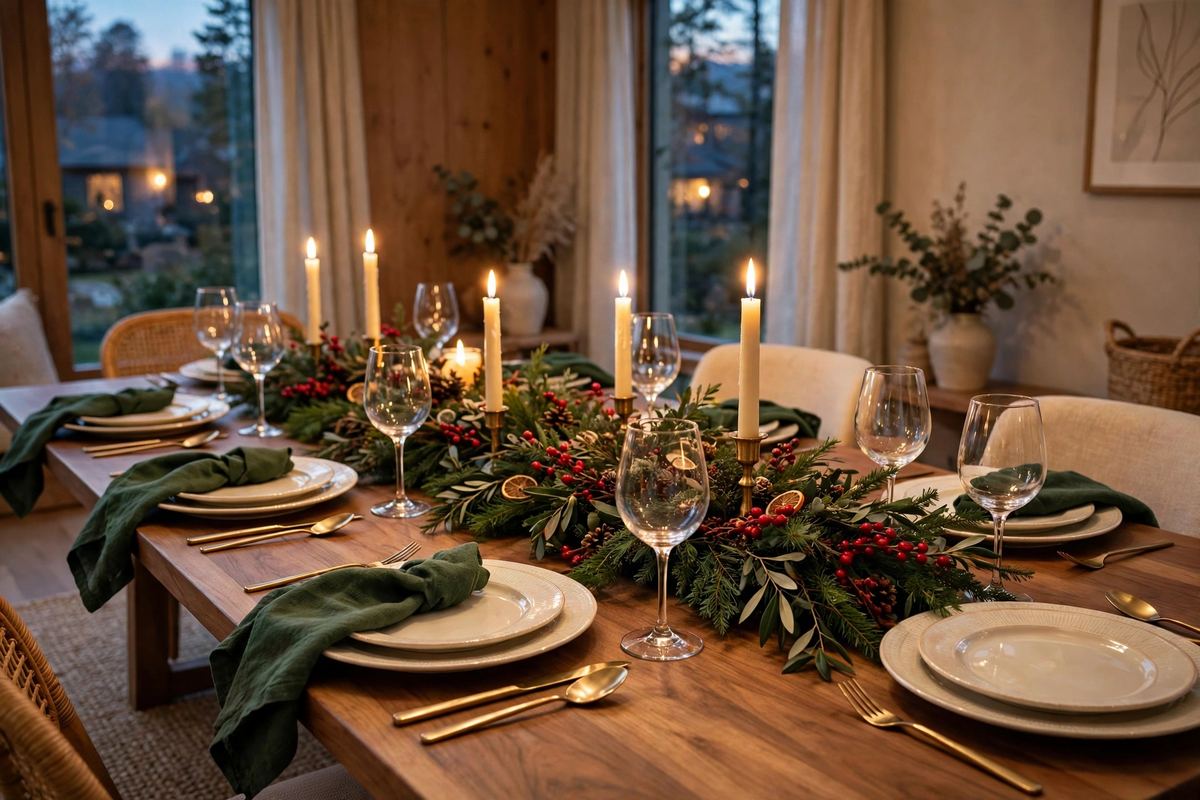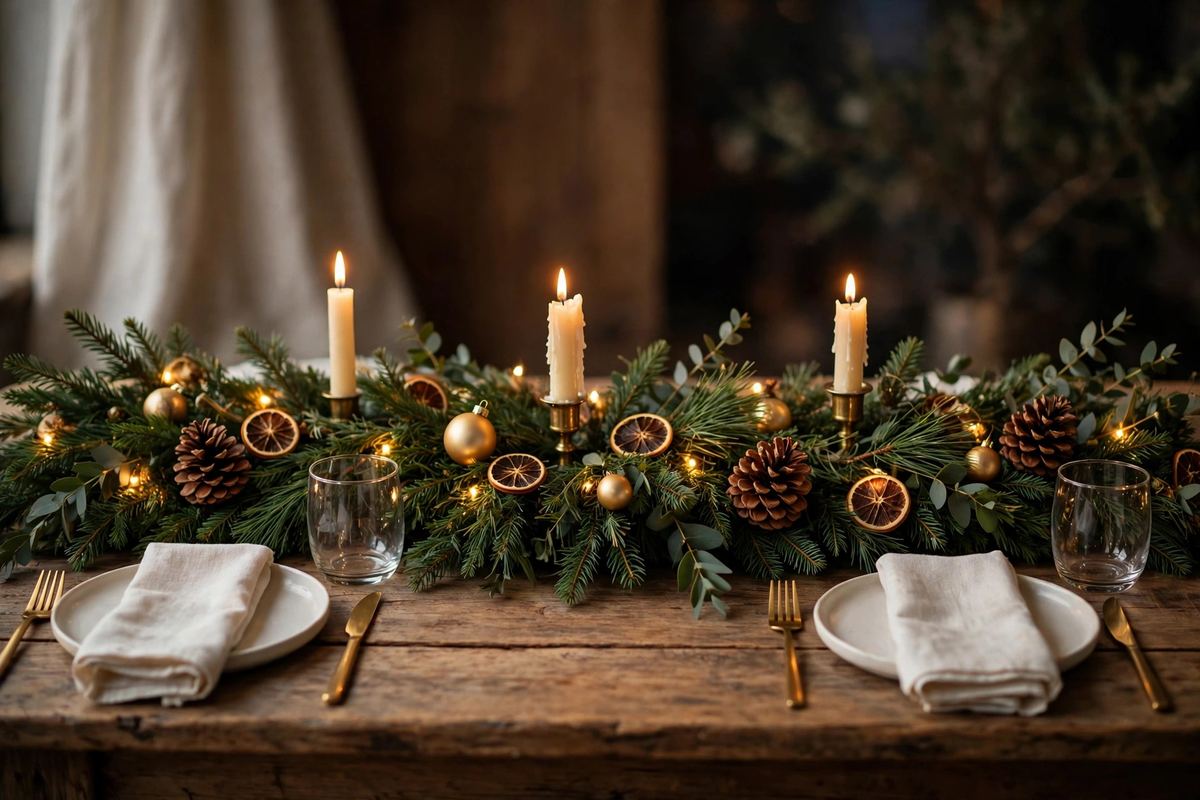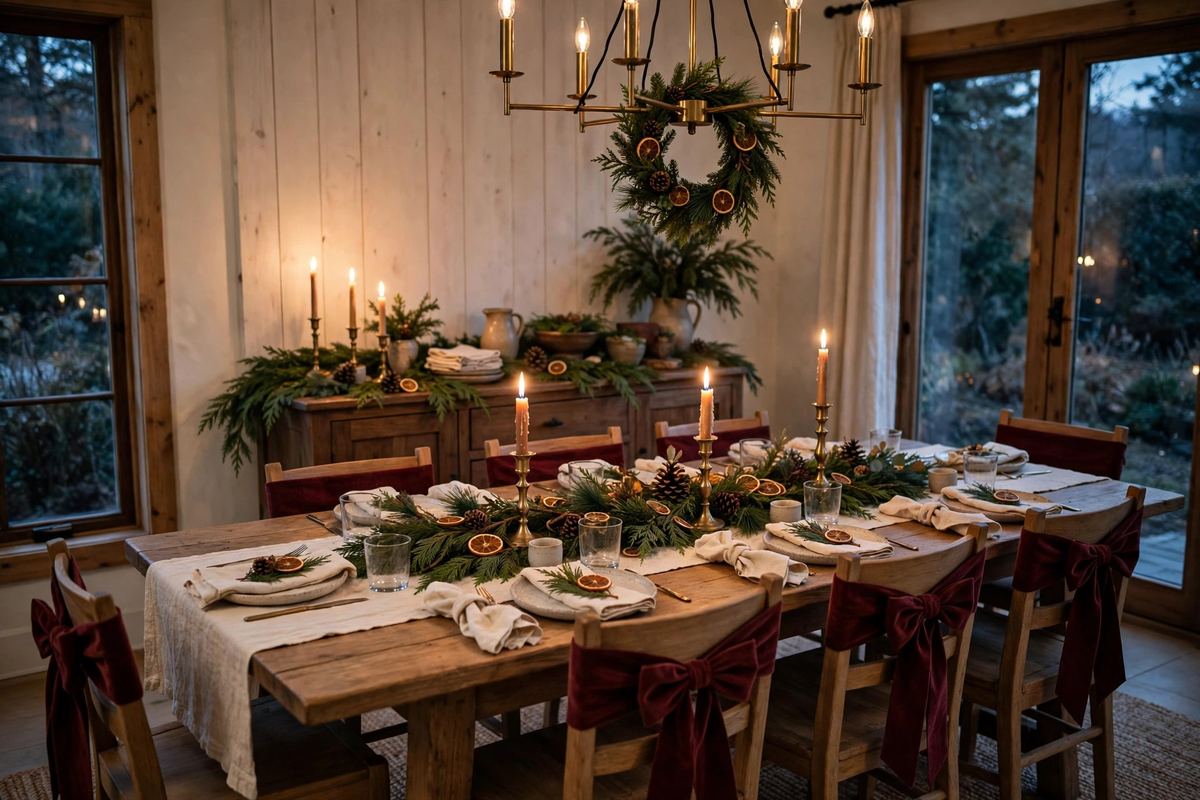
Here is the honest truth about Christmas dining room decor: guests do not remember the centerpiece. They remember walking into a room that glowed — the light low, the sideboard dressed, the chairs tied with velvet — and sitting down at a table that felt like the middle of something, not a display in an empty room. That is why a dining room decorated only at the table always feels slightly off, no matter how beautiful the table is. Christmas dining room decor ideas work when they treat the room as one scene: something above, something behind, something at every seat, and light that ties all three together.
This guide gives you 14 Christmas dining room decor ideas, grouped by where they go: four light ideas, three sideboard and serving ideas, four chair, wall, and table ideas, two small-room ideas, and one finishing layer for hosting night. Every idea carries a real cost. It sits inside the wider Christmas cluster — the table craft from our Christmas tablescape ideas, the makeable centerpieces in our DIY Christmas centerpiece ideas, and the garland know-how in our Christmas garland ideas — so the room and the table finally match.
Start With the 3 Rules for the Whole Room
Rule one: one palette, three surfaces. Pick one palette — the warm one this site keeps returning to, cream linen, cedar green, brass, and burgundy — and carry it across the chandelier, the sideboard, and the chairs. A room with one palette reads as decorated; a room with a red table, a gold sideboard, and silver chairs reads as a storage sale. You do not need matching sets, just matching colors: a burgundy bow on a chair, a burgundy candle on the sideboard, and a burgundy napkin at the table are enough to make the room feel planned. Rule two: decorate the edges, keep the middle clear. The dining room's job is a meal, so greenery, candles, and displays belong on the chandelier, the sideboard, the walls, and the window — and the table itself gets only a low centerpiece guests can see over. If a guest has to move a decoration to reach the salt, it is in the wrong place.
Rule three: warm light or nothing. Every light in the room at Christmas should be warm white, 2700K — the chandelier on a dimmer, fairy lights on the window, candles on the table — because one cool-white string among warm ones makes the whole room look cold, and a dining room mirror or window shows that mistake mercilessly. Turn the overhead light down to a glow, let the candles and fairy lights do the work, and the room will look expensive even if everything in it came from last year's bins. These three rules carry every idea below, and they are also why a dining room plan costs so little: you are dressing three surfaces and dimming one light, not redecorating a room.
Light From Above: Ideas 1 to 4
1. The chandelier wreath — $15 to $30, 15 minutes. This is the single highest-impact Christmas dining room idea there is, and it is the one guests photograph first: a 16- to 20-inch faux evergreen wreath hung from the chandelier's center stem on a wide velvet ribbon, so it floats above the table like a second centerpiece. A faux wreath costs $12 to $25, the ribbon $3 to $5, and the whole thing takes fifteen minutes. Choose a wreath slightly smaller than the chandelier's width so it hangs in proportion, and keep its bottom at least 30 inches above the tabletop so nobody has to talk around it. Use faux, never fresh, near a light fixture: fresh greenery dries out above a warm bulb, and a dry wreath over a candlelit table is a risk no room is worth.
2. The pendant greenery cluster — $10 to $20, 10 minutes. If you have pendant lights instead of a chandelier, hang one small sprig of faux cedar and a pinecone from each pendant cord with thin wire or ribbon, at staggered heights. Three pendants, three sprigs, $10 to $20 total, and the pendants stop looking like kitchen lighting and start looking like Christmas lighting. Keep the sprigs short — 6 to 8 inches — so they do not swing into anyone's face when someone pulls out a chair, and keep them clear of the bulbs themselves. This is the idea for a modern dining room where a big wreath would look wrong, and it works because it decorates the light you already have instead of adding a new fixture.
3. The dimmer and candle layer — $0 to $25, 5 minutes. The cheapest transformation on this list costs nothing if you already own a dimmer: turn the chandelier down to a glow and let the table candles carry the room. If you have no dimmer, a $15 to $25 plug-in dimmer or a set of warm-white LED taper candles on the table does the same job. Light all candles fifteen minutes before guests arrive so the room is already glowing when they walk in, and keep a long lighter handy for relighting through the evening. The rule from our Christmas tablescape ideas still applies: candle height should vary, but sight-lines stay clear, so use a mix of tall tapers at the sideboard and low votives on the table, never a forest of tall candles guests must peer around.
4. The window fairy-light frame — $8 to $15, 15 minutes. Run one warm-white fairy-light string around the dining room window frame, held with clear removable hooks, and let it glow from dusk onward. A string costs $8 to $15, the hooks $2 to $3, and the window becomes a second light source that makes the whole room feel deeper, because the eye travels to the glowing frame and then back to the table. This is the idea that matters most after dark, when the window would otherwise be a black rectangle: with lights, it is a picture; without them, it is a hole in the wall. Put the string on a timer so it comes on at dusk without anyone remembering it.
The Sideboard Is the Room's Stage: Ideas 5 to 7
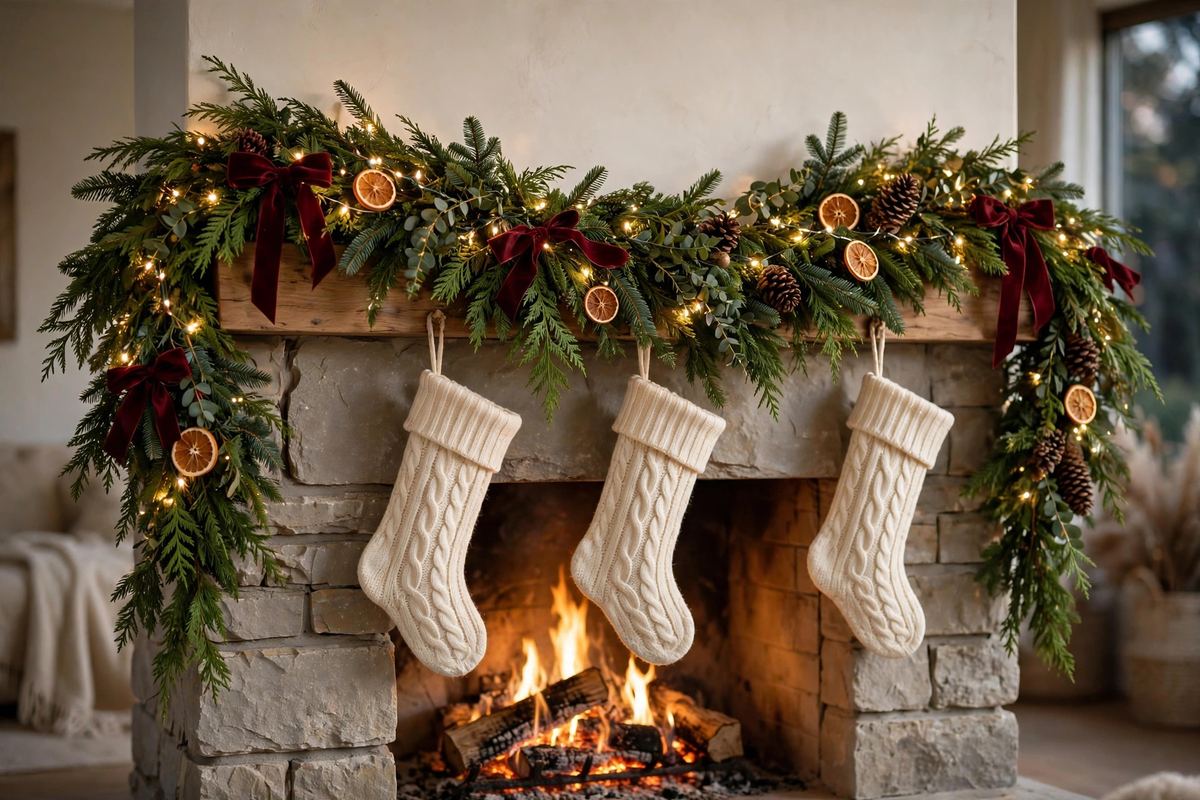
5. The sideboard garland — $20 to $40, 15 minutes. Lay a 6-foot faux cedar garland along the back edge of the sideboard, let it drape down at both ends, and weave one battery-operated fairy-light string through it. A faux garland costs $18 to $35, the lights $5 to $8, and the sideboard instantly becomes the room's backdrop, framing the table from behind in every photograph. Our Christmas garland ideas cover fresh versus faux in detail, and for a sideboard, faux wins outright: it never drops needles onto serving dishes, and it survives the whole season without a second thought. Keep the garland behind the serving dishes, not under them, so platters sit on a clear surface and the greenery reads as a frame, not a tablecloth.
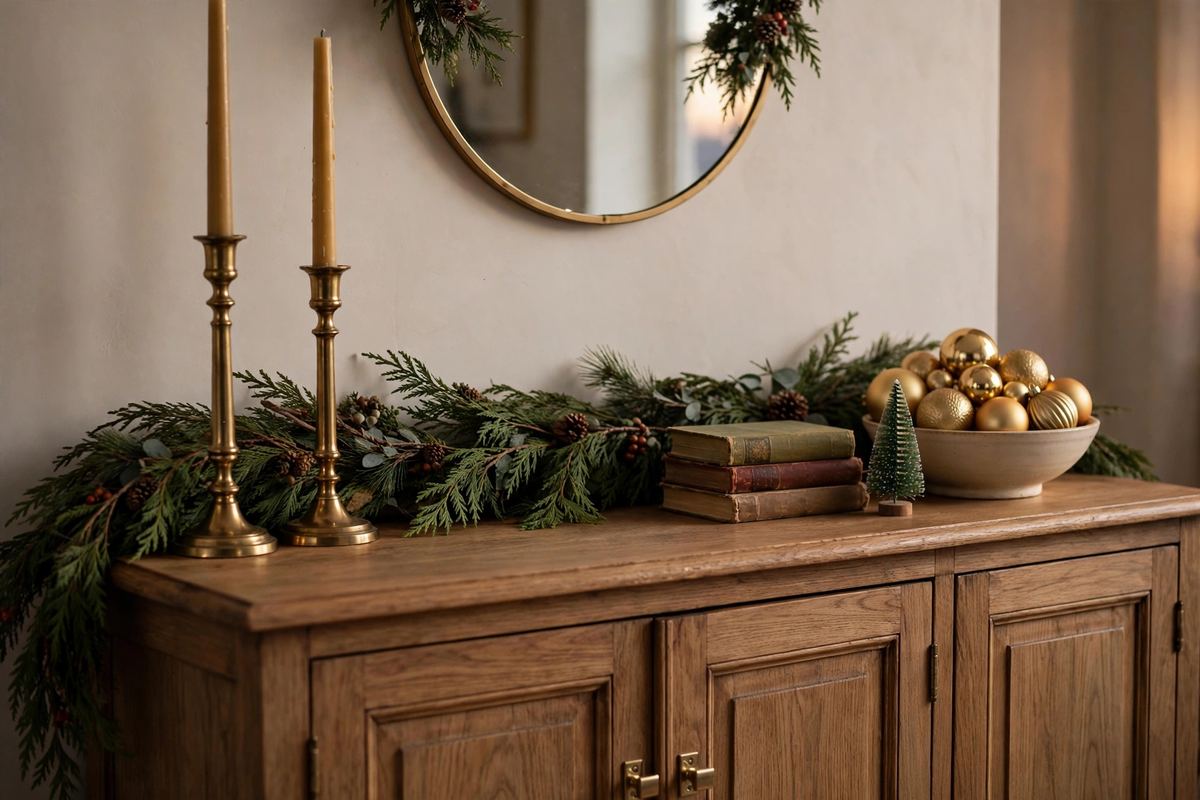
6. The sideboard display formula — $10 to $25, 10 minutes. Once the garland is down, style the sideboard in three parts: height at one end, a low cluster in the middle, and one tall piece at the other end. Height means tall brass candlesticks or a vase of branches. The low cluster means a stack of vintage books, a bowl of gold ornaments, and one tiny bottle-brush tree, exactly as in the photo above. The tall piece means a framed print, a mirror with a mini wreath, or a lantern. The three-part formula works because it gives the eye somewhere to land without crowding the surface — and it leaves the middle clear for serving dishes, which is the sideboard's real job on hosting night. Everything in the formula can come from other rooms: the books from a shelf, the bowl from a kitchen cupboard, the candlesticks from the mantel.
7. The drinks station — $0 to $20, 15 minutes. Turn the sideboard's far end, or a bar cart if you have one, into a self-serve drinks station: a tray with glasses, a bottle or two, a small bowl of oranges, and one sprig of greenery tied to the tray handle. The tray costs $0 if you already own one, $12 to $20 if you buy one, and the station solves the two biggest hosting problems at once: guests help themselves instead of hovering in the kitchen, and the table stays clear of bottles. Tie the station to the room's palette with one burgundy ribbon on the tray or one brass candle beside it, so it reads as part of the decor, not as clutter that wandered in from the kitchen.
Chairs, Walls, and the Table: Ideas 8 to 11
8. Velvet bows on every chair — $10 to $20, 20 minutes. Tie a wide burgundy velvet ribbon around the back of every dining chair, finished in a full bow, and the room transforms in twenty minutes for the price of two rolls of ribbon. Two rolls of 2.5-inch velvet ribbon cost $10 to $20, and one roll covers four to six chairs depending on the bow size. The trick is consistency: every chair gets the same bow, tied at the same height, so the chairs read as a set even if the chairs themselves do not match. Our velvet bow Christmas decor covers ribbon widths and bow shapes in detail, and the dining chair is where the velvet bow earns its keep most, because eight matching bows do more for a room than any single centerpiece.
9. Mini wreaths on the chair backs — $15 to $30, 15 minutes. If bows feel too soft for your room, hang one 8- to 10-inch mini faux wreath on the back of every other chair, alternating with a plain chair, so the wreaths read as a rhythm rather than a wall of green. Six mini wreaths cost $15 to $30, the ribbon to hang them $3 to $5, and the alternating pattern is the whole trick: every chair decorated looks busy, every other chair decorated looks considered. This is the idea for a farmhouse or rustic dining room — the look our farmhouse dining room ideas build from real wood and simple lines — where a wreath feels more at home than a velvet bow.
10. The wall swap — $0 to $15, 10 minutes. Swap one piece of everyday wall art for a Christmas print, or hang a mini wreath on the dining room mirror, and the wall behind the table joins the scene. A print costs $0 if you frame a page from a calendar or a greeting card, $10 to $15 if you buy one, and one swapped piece is enough — a whole gallery wall of Christmas prints looks like a shop, while one festive frame among everyday art looks like a home that happens to be celebrating. If your dining room has a mirror, hang the wreath on it instead: a wreath on a mirror doubles in the reflection, and a mirror is the one wall piece that makes a small dining room feel bigger while it decorates.
11. The table layer beyond the centerpiece — $15 to $35, 20 minutes. The centerpiece gets all the attention, but the table layer is what guests actually touch: a runner in the room's palette, placemats that echo it, and one folded napkin with a sprig of greenery tucked into the ring. A runner costs $10 to $20, placemats $8 to $15 for a set if you buy new, and the napkin sprig costs nothing if you clip it from the garland offcuts. Keep the centerpiece low — under 12 inches — so guests can see each other over it, and let the runner and napkins carry the color instead. The full table craft, including the 5-layer setting formula and candle height rules, lives in our Christmas tablescape ideas, and the makeable centerpieces in our DIY Christmas centerpiece ideas pair with this layer rather than competing with it.
The Small Dining Room: Ideas 12 and 13
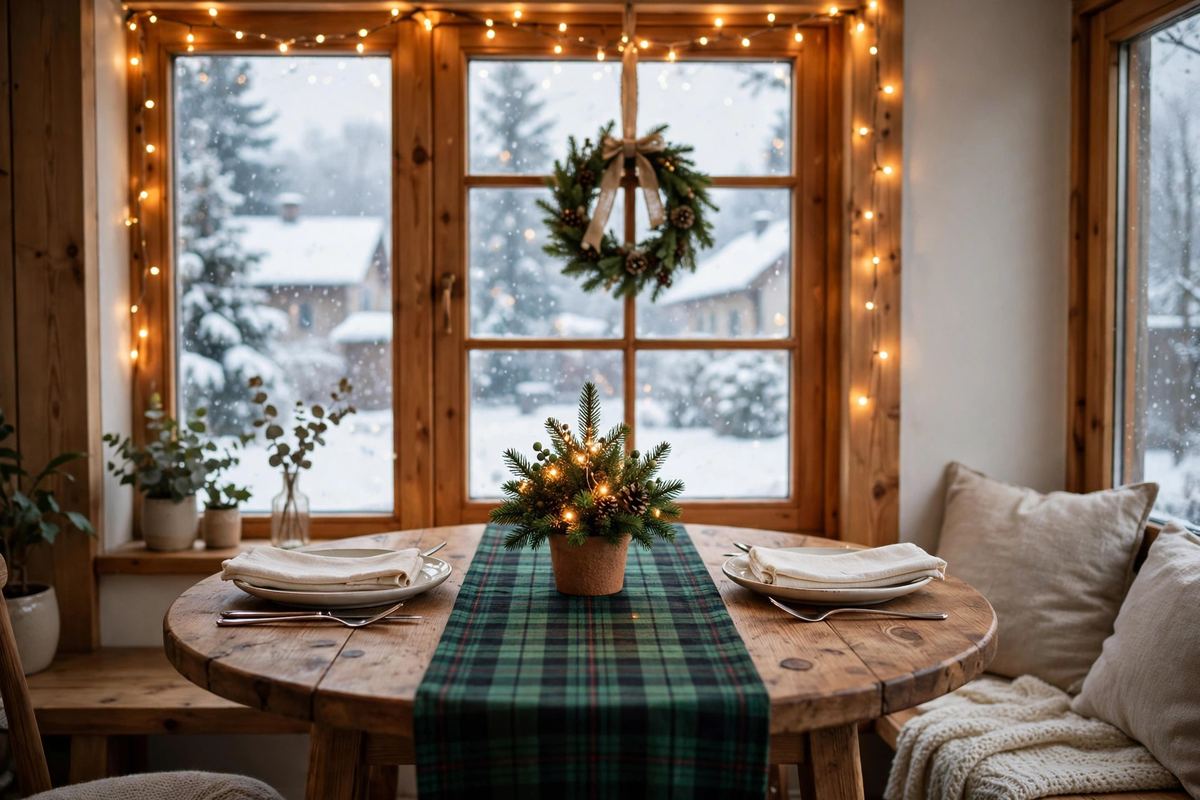
12. The dining nook formula — $20 to $40, 30 minutes. A small dining room or a breakfast nook needs a smaller plan, not a sadder one: a wreath on the window, fairy lights on the window frame, a plaid runner on the table, and one lit mini evergreen as the centerpiece, exactly as in the photo above. A mini tree costs $12 to $20, the runner $8 to $15, the wreath and lights $10 to $15 if you buy them new, and the whole nook takes thirty minutes. The rule for a small room is to decorate up, not out: the window, the light, and the wall carry the Christmas, and the floor stays completely clear, because a small room with decor on the floor reads as clutter within a day. A round table helps here, because a round table has no corners for guests to bump and no head of the table to crowd.
13. The seasonal swap kit — $0, 10 minutes. Small rooms cannot store a roomful of Christmas decor, so keep a swap kit instead: one box holding the runner, the chair ribbons, the wreath, and the fairy-light string, and change only those four things. The base — the table, the chairs, the sideboard, the everyday dishes — stays the same all year, and the swap takes ten minutes in December and ten minutes in January. Label the box, keep it where you can reach it without moving three other boxes, and next year's dining room takes an evening, not a weekend. This is the idea that makes all the others sustainable: a dining room you can decorate in an evening is a dining room that actually gets decorated, every year, instead of once and never again.
The Finishing Layer: Idea 14 and Hosting Night
14. Scent, sound, and the first ten minutes — $8 to $15, 5 minutes. The last layer is not visual at all: one scent, one playlist, and a room that is already glowing when guests walk in. A fir or cinnamon reed diffuser on the sideboard costs $8 to $15, a playlist costs nothing, and the combination does what no decoration can — it makes the room feel like Christmas before anyone looks at a single wreath. Keep it to one scent, kept light, because a dining room with two competing scents smells like a shop. Then, on hosting night, run the ten-minute check: light the candles fifteen minutes before guests arrive, turn the chandelier down to a glow, clear the sideboard's middle for serving dishes, put drinks on the station, and step back. If you can walk from the door to your chair without moving a decoration, the room is ready — and the table, which is the whole point, finally has a room worthy of it.
The Weekend Plan and Real Costs
Start on a Saturday morning with the light: hang the chandelier wreath or the pendant sprigs first, because they are the biggest visual change and they set the palette for everything else. Next, dress the sideboard — garland along the back edge, then the three-part display, then the drinks station at the far end. Then tie the chair bows or hang the chair wreaths, swap the wall art, and lay the table layer: runner, placemats, napkin sprigs. Finally, add the window lights and the diffuser, dim the chandelier, and step back to check sight-lines: sit in a chair, look across the table, and confirm you can see the opposite guest's face under the wreath and over the centerpiece. If you cannot, raise the wreath or lower the centerpiece before anyone arrives. The whole plan takes one relaxed afternoon, and most of that afternoon is deciding, not doing.
On cost, a full Christmas dining room plan — a chandelier wreath and ribbon, a sideboard garland and lights, chair ribbons, a runner, a diffuser, and window lights — runs about $90 to $160 if you buy everything new. A room-only plan, skipping the table layer you may already own, costs $60 to $100, and a small-nook plan — a wreath, a runner, a mini tree, and window lights — costs $35 to $60. The best value on the list is the velvet chair bows at $10 to $20, because eight matching bows change the room more than any single purchase. When January comes, pack the wreath, the garland, the ribbons, and the runner into one labelled box, and next December the dining room takes an evening, not a weekend.
Mistakes to Avoid
- Decorating only the table. A beautiful table in a bare room feels like a display. Dress the light above, the wall behind, and the chairs around it too.
- Hanging the wreath too low. A chandelier wreath that blocks eye contact ruins conversation. Keep its bottom at least 30 inches above the tabletop.
- Using fresh greenery near lights. Fresh greenery dries out above a warm bulb. Use faux near any fixture, and fresh only in a vase you can replace.
- Mixing light colors. One cool-white string among warm-white lights ruins the glow. Check for 2700K on every string before you hang it.
- Crowding the table. A centerpiece over 12 inches tall blocks faces. Keep the centerpiece low and let the runner and napkins carry the color.
- Blocking the sideboard's middle. The sideboard's job on hosting night is serving dishes. Keep its middle clear and decorate the edges.
- Two competing scents. A dining room with two scents smells like a shop. One scent, kept light, is the whole scent plan.