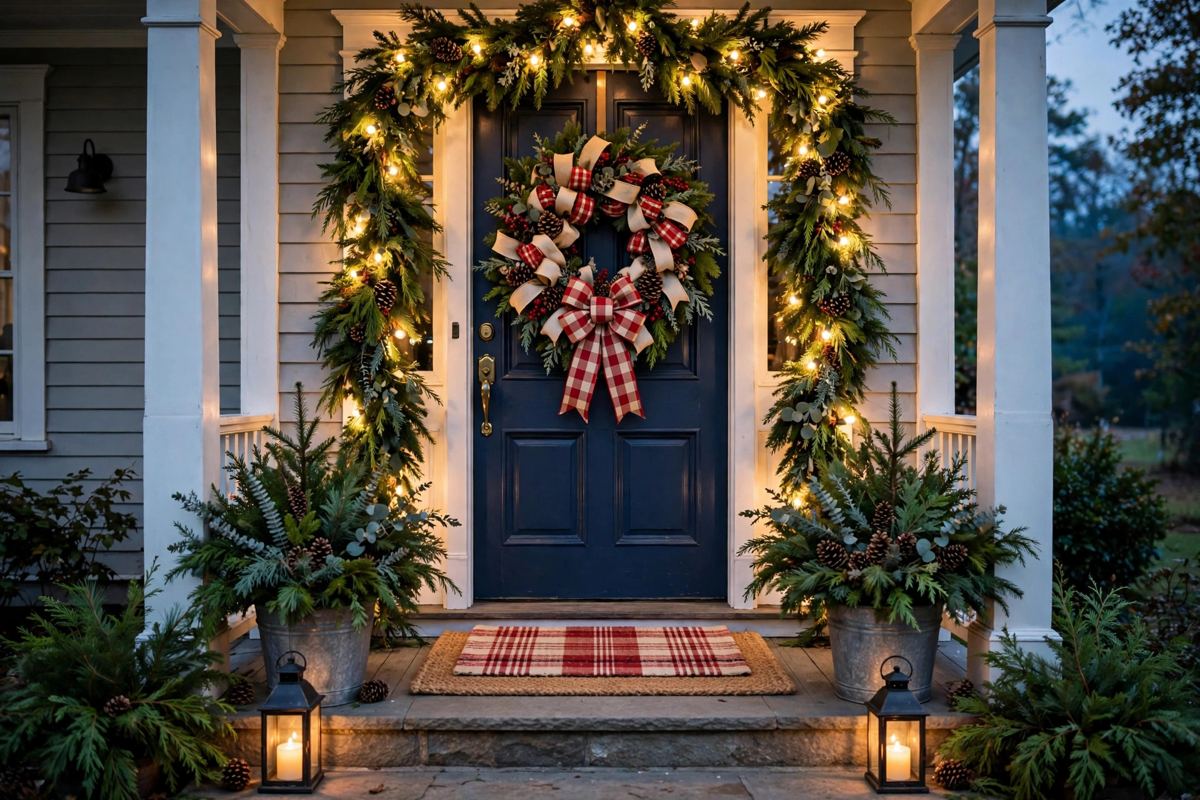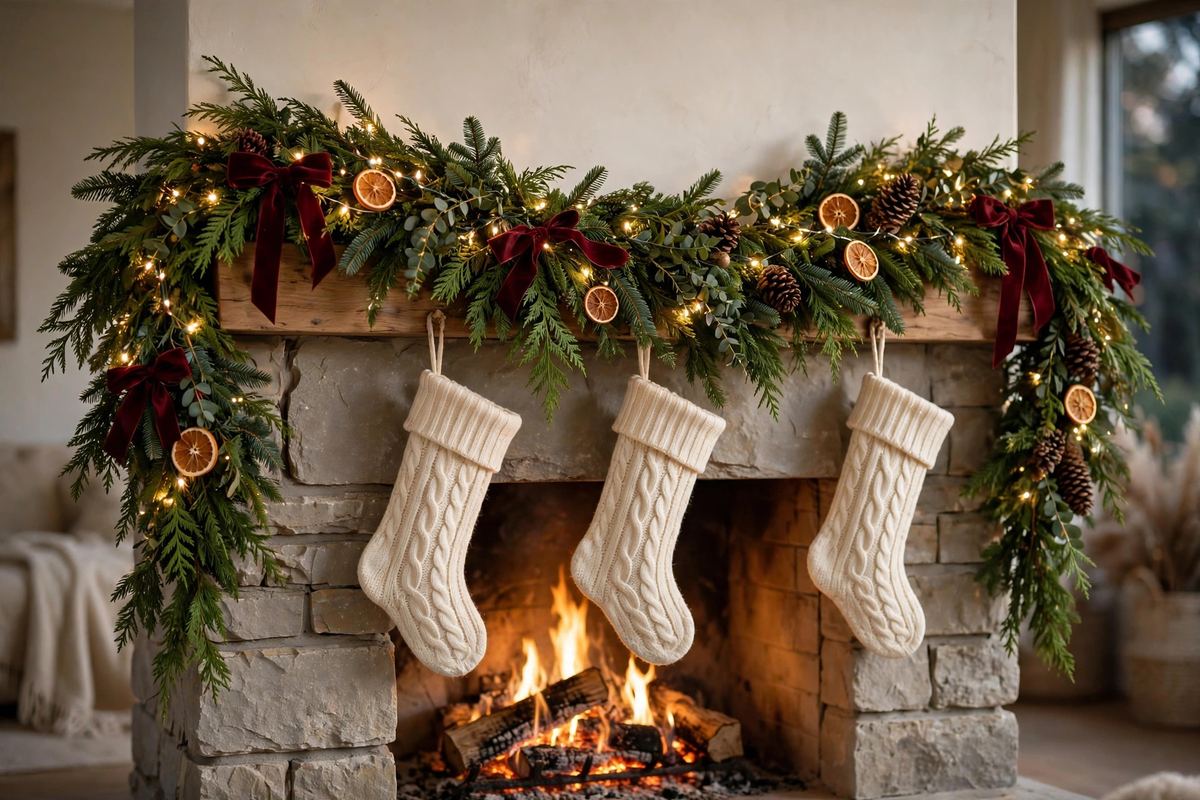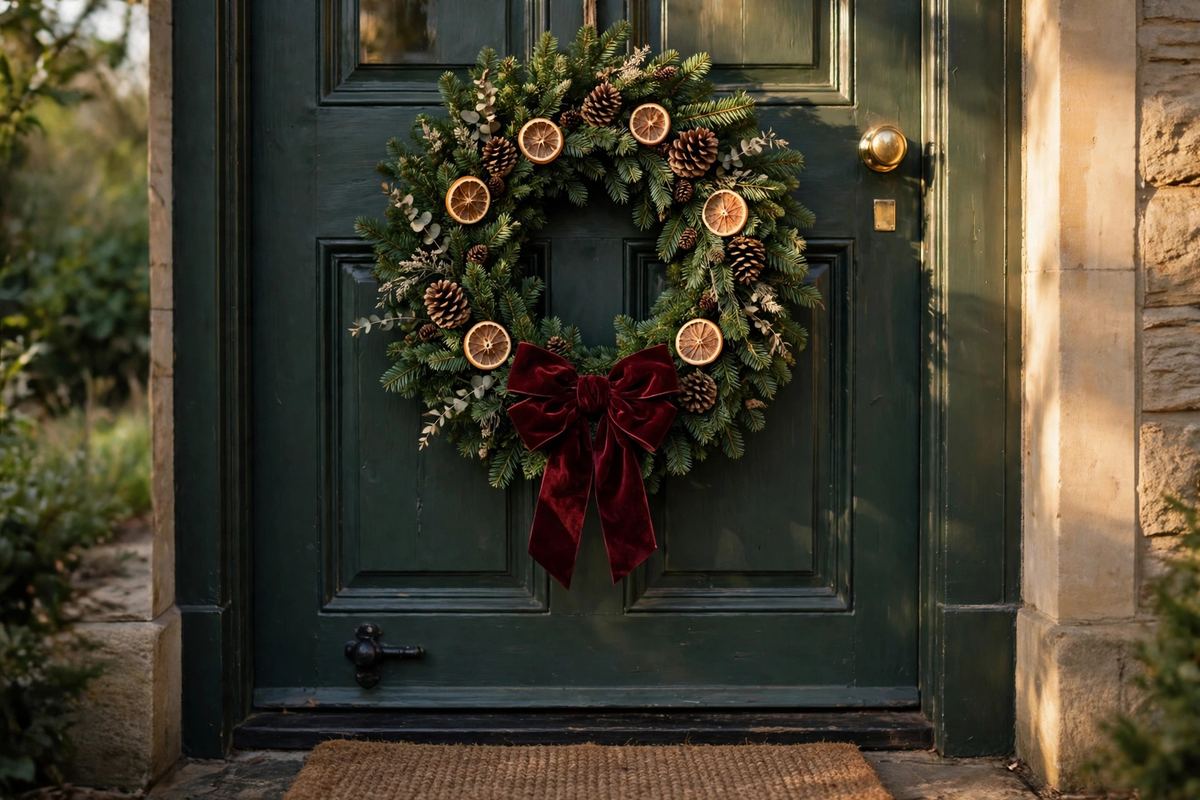
Here is the honest truth about Christmas entryway decor: guests decide how your home feels in the first three seconds, standing in the doorway with cold hands and a coat over one arm. If the entryway is bare, the beautiful living room beyond it still starts at a disadvantage — the welcome was flat. If the entryway glows, with greenery on the console and a lantern lit by the door, the whole house feels warmer before anyone takes a step inside. Christmas entryway decor ideas work when they treat this small space as a greeting, not a display: something green, something glowing, and somewhere to put your keys, all within arm's reach of the door.
This guide gives you 13 Christmas entryway decor ideas, grouped by where they go: four console ideas, three door and wall ideas, three floor and bench ideas, two ideas for entries with no console at all, and one finishing layer for hosting night. Every idea carries a real cost. It sits inside the wider Christmas cluster — the outdoor welcome in our front porch Christmas decor ideas, the garland know-how in our Christmas garland ideas, and the wreath styles in our Christmas wreath ideas — so the walk from the street to the living room feels like one continuous welcome.
Start With the 3 Rules for an Entryway
Rule one: greet, do not block. Everything in an entryway must leave a clear path from the door to the next room, wide enough for a person carrying a bag and a coat. Decorate the console, the wall, and the top of the bench — never the walking line itself, and never the door swing. If a guest has to sidestep a lantern or duck under a swag to get inside, the decor has failed at its only job. Rule two: one palette, carried inside. Pick the warm palette this site keeps returning to — cream, cedar green, brass, and burgundy — and carry it from the porch through the entryway into the living room, so the house reads as one home instead of three separate decorations. A burgundy bow on the entryway wreath, a burgundy runner on the hall floor, and a burgundy throw on the bench are enough to tie the whole route together.
Rule three: keep the everyday jobs working. An entryway at Christmas still has to hold keys, mail, coats, and shoes, and a console buried under decor stops doing that within a week — which is when the clutter starts piling up beside it. Every idea below keeps one clear landing spot for keys and one place for bags or shoes, because an entryway that still works in January is an entryway that still looks good in January. These three rules carry every idea below, and they are why an entryway plan costs so little: you are dressing one surface, one wall, and one light, not redecorating a room.
The Console Is the Stage: Ideas 1 to 4
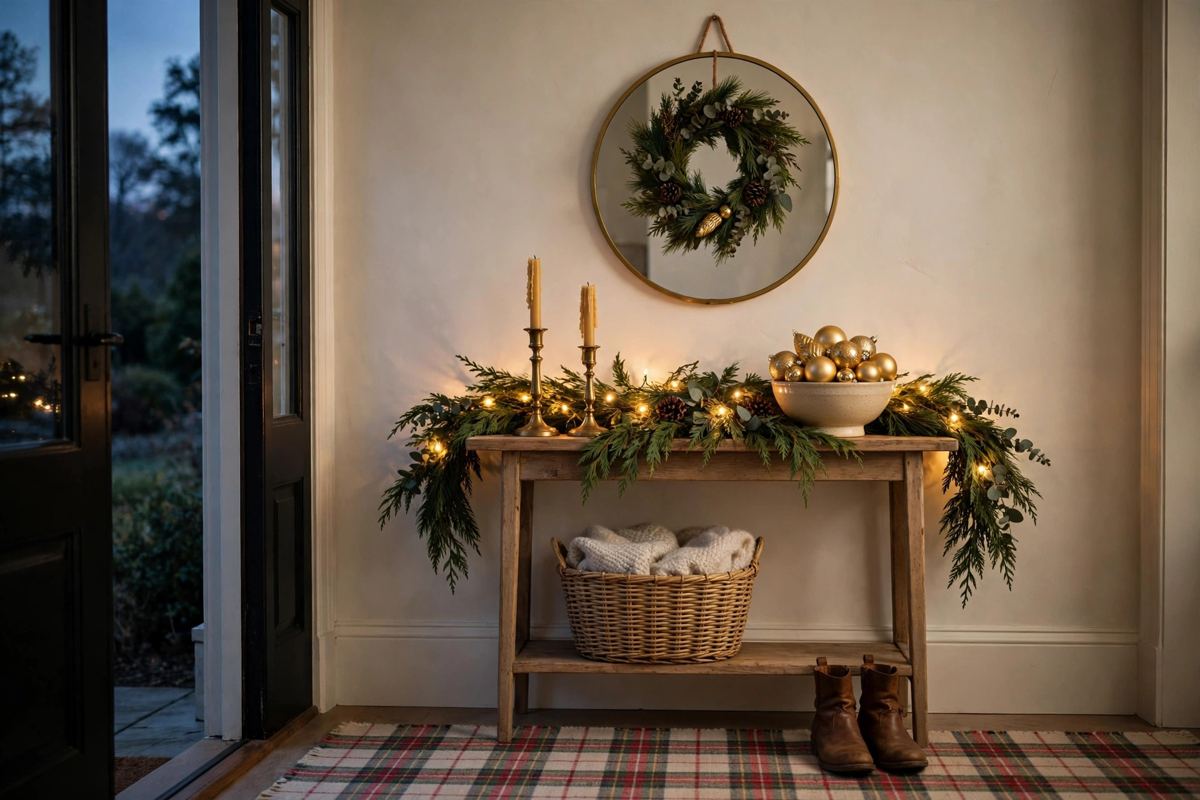
1. The console garland — $18 to $35, 15 minutes. This is the single highest-impact Christmas entryway idea there is: a 6-foot faux cedar garland laid along the back edge of the console, its ends draping down both sides, with one battery-operated warm-white fairy-light string woven through it. A faux garland costs $18 to $35, the lights $5 to $8, and the console instantly becomes the room's greeting, as in the photo at the top of this article. Our Christmas garland ideas cover fresh versus faux in detail, and for an entryway, faux wins outright: a console garland sits right by a door that opens onto cold air and wet boots, and fresh greenery there dries out and drops needles onto the keys and mail within days. Fluff the faux branches outward before you lay it down, so it looks full from the front door, not flat.
2. The mirror wreath — $15 to $30, 10 minutes. Hang one 18- to 24-inch wreath on the mirror or the wall above the console, centered on the console's width, and the entryway gains a focal point without losing a single inch of surface. A faux wreath costs $12 to $25, the ribbon to hang it $3 to $5, and the effect doubles if the wreath hangs on a mirror, because the greenery reflects and the fairy lights bounce back into the room. Choose a wreath slightly narrower than the console so it hangs in proportion — a wreath wider than the table looks like it is wearing the console, not decorating it. Our Christmas wreath ideas cover styles and sizing, and the entryway is where the simplest wreath wins: one evergreen ring, one bow, nothing else competing with the garland below it.
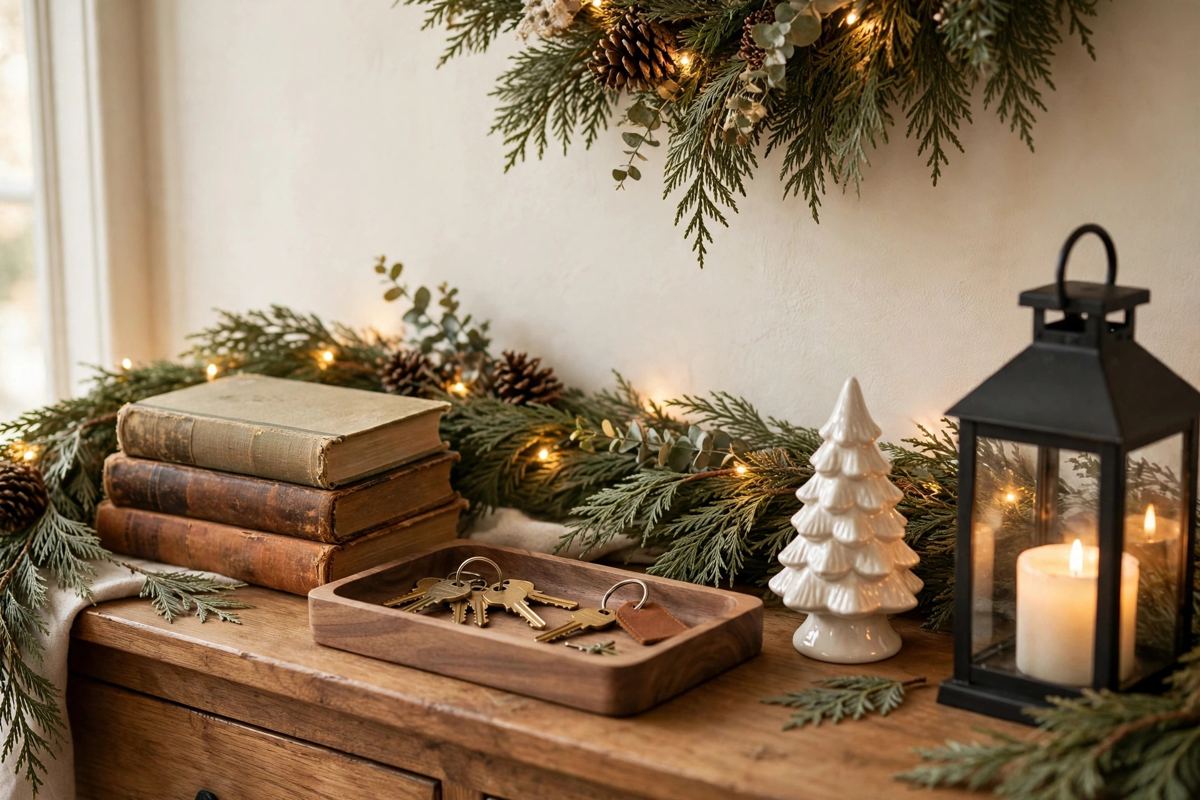
3. The catch-all tray and ornament bowl — $8 to $20, 5 minutes. An entryway console needs one landing spot, and Christmas gives it a festive disguise: a shallow wooden tray for keys at the front of the console, and a wide bowl of gold ornaments beside it for mail, sunglasses, and small essentials, exactly as in the photo above. The tray costs $8 to $15, the bowl $0 if you already own one, and the trick is placement — the tray goes at the front edge, where a hand naturally lands when you walk in, and the bowl goes behind it, so the keys never migrate into the garland. Use large ornaments, not small ones, in the bowl: small ornaments roll, get lost under the mail, and end up on the floor by the second week of December.
4. The three-part console formula — $10 to $25, 10 minutes. Once the garland is down, style the console in three parts: height at one end, a low cluster in the middle, and one clear landing spot at the other end. Height means a lantern with a glowing candle or tall brass candlesticks. The low cluster means a stack of vintage books, a small ceramic tree, and one bowl of ornaments. The landing spot means the key tray, kept deliberately empty of decor. The three-part formula works because it gives the eye somewhere to land without crowding the surface — and it leaves room for the things the console is actually for. Everything in the formula can come from other rooms: the books from a shelf, the lantern from the mantel, the bowl from a kitchen cupboard.
Doors, Mirrors, and Walls: Ideas 5 to 7
5. The doorway garland swag — $20 to $40, 20 minutes. Drape a garland over the interior doorway between the entryway and the next room — or across the top of a wide cased opening — letting it dip in the middle and hang longer at the sides, and the entryway stops feeling like a corridor and starts feeling like a threshold. A 9-foot faux garland costs $20 to $35, the hooks $3 to $5, and the swag is the idea that ties the entryway to the rest of the house: guests walk under Christmas to get to Christmas. Hang it high enough that the lowest point clears the tallest guest's head by at least 6 inches, and keep it off the door itself if that door swings — a swag on a swinging door gets crushed within a day. This pairs with the outdoor garland arch in our front porch Christmas decor ideas, so the doorway echoes the front door from the inside.
6. The stocking rail — $12 to $25, 15 minutes. If the mantel is already full, the entryway wall is the second home for stockings: mount a row of three to five sturdy hooks on the wall beside the console, or a slim wall rail, and hang one stocking per person at staggered heights. A rail or a set of hooks costs $12 to $25, the stockings $0 if you already own them, and the entryway stockings solve a real problem — they give children a place to look the moment they walk in, without anyone having to trek to the living room. Our Christmas stocking ideas cover styles and mantel holders, and the same rule applies on a wall: each hook must hold the stocking's full weight when filled, so screw into a stud or use a proper wall anchor, never a sticky hook, for a stocking that will hold gifts. Keep the rail clear of the door swing and the coat hooks, or the stockings become the first thing a coat knocks down.
7. The wall swap and the sconce glow — $0 to $20, 10 minutes. Swap one piece of everyday entryway art for a Christmas print, or hang a mini wreath on the entryway mirror, and the wall behind the console joins the scene for almost nothing. A print costs $0 if you frame a page from a calendar or a greeting card, $10 to $20 if you buy one, and one swapped piece is enough — a whole gallery wall of Christmas prints looks like a shop, while one festive frame among everyday art looks like a home that happens to be celebrating. If your entryway has a wall sconce or a small lamp, put it on a timer with a warm-white bulb: a lit sconce at dusk is the difference between an entryway that looks decorated and one that looks occupied, and it costs nothing after the bulb.
Floors, Benches, and Light: Ideas 8 to 10
8. The bench, throw, and basket — $15 to $35, 10 minutes. If your entryway has a bench, dress it the way you would a chair: a chunky cream knit throw folded over one end, one plaid cushion against the wall, and a woven basket underneath for shoes, gloves, and scarves. The throw costs $0 if you already own one, $12 to $20 if you buy one, the basket $10 to $18, and the bench becomes the entryway's softest moment — the place where a guest sits to take off boots, and where the house first feels like it can be lived in. Keep the middle of the bench clear enough to actually sit on: a bench buried under cushions is a display, not a seat, and guests will stand awkwardly with their boots on instead. The basket underneath is the whole storage plan — one basket, everything inside it, nothing on the floor beside it.
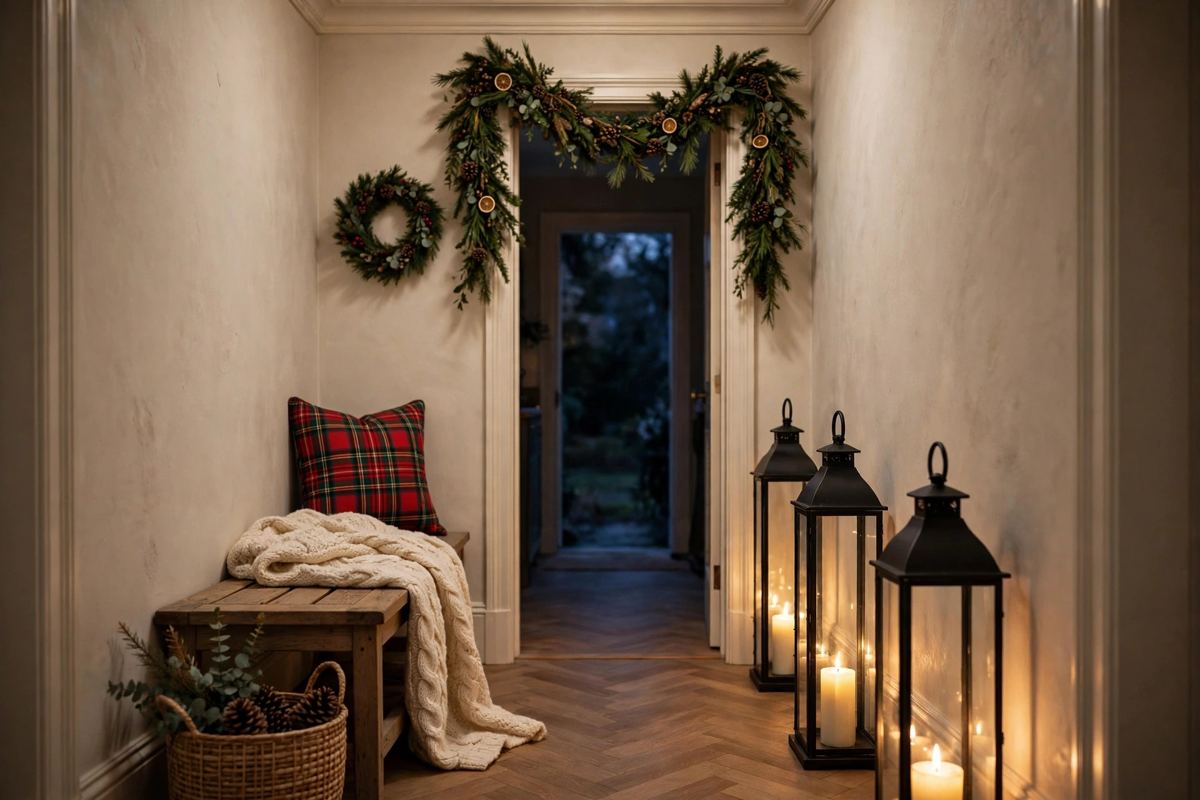
9. The lantern path — $15 to $40, 10 minutes. Line one wall of the entryway or hall with two or three lanterns of graduated heights, each holding a battery-operated pillar candle, and the floor itself starts to glow. Lanterns cost $15 to $40 for a set, the candles $5 to $10, and the path works because it lights the route guests actually walk, instead of lighting a surface they only look at. Keep every lantern hard against the wall, never in the walking line, and use battery candles here without exception: a real flame at ankle height, beside coats and a basket of scarves, is a risk no hallway is worth. Put the candles on a timer so the path lights itself at dusk, and the entryway greets the first guest home from work without anyone remembering to switch it on.
10. The runner and layered doormat — $15 to $35, 10 minutes. Lay a washable runner down the hall from the door — plaid, or a deep red that echoes the wreath bow — and layer the doormat outside-to-in: a coir mat at the door, a slightly larger patterned mat beneath it if the porch allows. The runner costs $12 to $25, the mats $8 to $15 if you buy new, and the runner does three jobs at once: it adds color, it softens hard floors, and it protects them from wet boots and muddy paws through the whole season. Choose a low-pile, washable runner, because a Christmas runner that cannot survive December is a January regret, and keep the runner's edges flat with rug tape so nobody trips on a curled corner in the dark. This is the idea that matters most in a house with a long hall, where the entryway and the living room are separated by a stretch of bare floor — the runner turns that stretch into part of the welcome.
No Console? No Problem: Ideas 11 and 12
11. The wall-hook entry — $10 to $25, 20 minutes. No console, no bench, just a wall and a door: mount a row of sturdy hooks, hang one small wreath above them, and put one slim basket on the floor beneath for shoes. The hooks cost $10 to $20, the basket $8 to $15, and the wall-hook entry works because it decorates vertically — the wreath at eye level, the hooks below it, the basket at the floor — instead of demanding a surface the space does not have. Hang the wreath high enough that coats hung below it do not swallow it, and keep one hook permanently free for a guest's coat, because an entryway with no free hook tells a guest their coat is a problem. A small wall-mounted shelf, no deeper than 6 inches, can hold keys above the hooks if the wall allows it, and that shelf plus the basket is the entire furniture plan.
12. The door-only entry — $0 to $20, 10 minutes. The smallest entryway of all — a door that opens straight into a room — still gets a Christmas welcome: one wreath on the inside of the front door, one lantern on the floor beside it, and one festive doormat underfoot. The wreath costs $0 if you move the outdoor wreath's twin inside, $12 to $20 if you buy one, and the door-only entry is the idea for a flat or a small house where the entryway is a threshold, not a room. Hang the wreath on the inside face with an over-door hook, so it greets you when you come home instead of only greeting visitors, and keep the lantern hard against the wall on the hinge side, never the handle side, so the door never swings into it. If your home has stairs rising from the entry, carry the look up one flight with the stair garland in our Christmas staircase decor ideas, and the threshold becomes a whole route.
The Finishing Layer: Idea 13 and Hosting Night
13. Scent, sound, and the first ten minutes — $8 to $15, 5 minutes. The last layer is not visual at all: one scent, one timer, and an entryway that is already glowing when guests arrive. A fir or cinnamon reed diffuser on the console costs $8 to $15, the fairy-light and lantern timers cost nothing once set, and the combination does what no decoration can — it makes the entryway smell like Christmas before anyone looks at a single wreath. Keep it to one scent, kept light, because an entryway with two competing scents smells like a shop, and a strong diffuser in a small hall is overwhelming within minutes. Then, on hosting night, run the ten-minute check: lights on timers already glowing, key tray clear, one hook free for a guest's coat, basket for shoes by the door, and a clear path from the door to the living room. If you can walk from the door to your chair without moving a decoration, the entryway is ready — and the house, which is the whole point, finally starts with a proper hello.
The Weekend Plan and Real Costs
Start on a Saturday morning with the wall: hang the mirror wreath or the doorway swag first, because they are the biggest visual change and they set the height for everything else. Next, lay the console garland along the back edge, weave in the fairy lights, and style the three-part formula — lantern at one end, books and tree in the middle, key tray clear at the front. Then dress the bench or the wall hooks, lay the runner, and set the lantern path hard against the wall. Finally, add the diffuser, set every light on a timer for dusk, and step back to check the path: walk from the door to the living room carrying a bag, and confirm nothing needs sidestepping. If something does, move it to the wall before anyone arrives. The whole plan takes one relaxed evening, and most of that evening is deciding, not doing.
On cost, a full Christmas entryway plan — a console garland and lights, a mirror wreath, a key tray and ornament bowl, a lantern set, a runner, and a diffuser — runs about $85 to $160 if you buy everything new. A console-only plan, skipping the bench and lantern path, costs $45 to $80, and a door-only plan — a wreath, a lantern, and a doormat — costs $20 to $40. The best value on the list is the console garland at $18 to $35, because one garland changes the entryway more than any single purchase. When January comes, pack the garland, the wreath, the runner, and the lantern candles into one labelled box, and next December the entryway takes an evening, not a weekend.
Mistakes to Avoid
- Blocking the path. A lantern or basket in the walking line ruins the welcome. Decorate the console, the wall, and the bench — never the route itself.
- Hanging the swag too low. A doorway garland that brushes heads gets ducked under, then torn down. Keep its lowest point at least 6 inches above the tallest guest.
- Burying the key tray. A console with no clear landing spot breeds clutter beside it within a week. Keep the tray at the front edge, empty of decor.
- Using fresh greenery by the door. Cold air and wet boots dry fresh garland fast. Use faux in the entryway, and fresh only in a vase you can replace.
- Real flames at ankle height. Lantern candles beside coats and scarves must be battery-operated. Save real candles for the console, up high, where they can be seen.
- Two competing scents. An entryway with two scents smells like a shop. One scent, kept light, is the whole scent plan.
- Matching the porch, not the house. Outdoor decor is weatherproof and bold; indoor entryway decor is softer. Let the porch be the porch, and keep the entryway warm and calm.